TL;DR: Water damage restoration in Macomb, MI typically costs $1,800 to $12,000 for most residential losses. A single room with clean water runs $1,500 to $4,000. A finished basement with contaminated water can reach $15,000 or more. The biggest cost drivers are the category of water (clean, gray, or black), the square footage affected, the materials involved (drywall, hardwood, insulation), and how fast extraction starts. Every loss is different, a written scope before work begins is the only number that actually applies to your home.
You just found standing water in your Macomb home. Maybe it’s a burst pipe in the laundry room, a sump pump that gave out during a heavy Michigan rain, or a slow leak behind the vanity that finally soaked through the subfloor. Whatever the cause, the first question most homeowners ask is: how much is this going to cost me? This post gives you real dollar ranges broken out by loss size, water type, and the line items your insurance adjuster will expect to see, not a vague “call for a quote” dodge.
How Much Does Water Damage Restoration Cost in Macomb, MI?
Most water damage restoration jobs in Macomb fall between $1,800 and $12,000, with the national average sitting around $3,500 for a mid-size residential loss. That range is wide because the variables are wide. A Category 1 (clean water) pipe break caught within four hours in a single carpeted bedroom is a very different job from a Category 3 (sewage-contaminated) basement flood in a finished space with drywall, carpet, and stored belongings.
Here is how cost breaks down by loss scenario:
| Loss Scenario | Typical Cost Range |
|---|---|
| Single room, clean water (Cat 1) | $1,500 - $4,000 |
| Single room, gray water (Cat 2) | $2,500 - $6,000 |
| Finished basement, clean water | $4,000 - $9,000 |
| Finished basement, gray or black water | $7,000 - $18,000 |
| Whole first floor, clean water | $6,000 - $14,000 |
| Whole first floor, gray or black water | $10,000 - $25,000+ |
| Crawl space flooding | $1,500 - $5,000 |
| Appliance leak (dishwasher, washing machine) | $1,000 - $3,500 |
These are industry-typical ranges for Southeast Michigan. Labor rates, material costs, and disposal fees in Macomb County are broadly in line with the metro Detroit market.
What Does Water Damage Restoration Cost Per Square Foot?
Per-square-foot pricing gives you a quick sanity check against a contractor’s estimate. Mitigation alone (extraction, drying, antimicrobial treatment) typically runs $3.75 to $7.00 per square foot for clean water losses. Add reconstruction and that number climbs to $8 to $20 per square foot depending on the finish level.
| Water Category | Mitigation Only (per sq ft) | Mitigation + Basic Reconstruction (per sq ft) |
|---|---|---|
| Category 1 (clean) | $3.75 - $5.50 | $8 - $14 |
| Category 2 (gray) | $5.00 - $7.50 | $10 - $18 |
| Category 3 (black/sewage) | $7.00 - $12.00 | $14 - $25+ |
A 400-square-foot finished basement flooded by a backed-up drain (Category 3) could realistically hit $4,800 to $10,000 in mitigation alone before a single sheet of drywall goes back up. That math surprises a lot of homeowners who expected a simpler number.
For the technical definitions behind these categories, the IICRC S500 Standard for Professional Water Damage Restoration is the industry reference that adjusters and contractors both use.
What Line Items Will My Insurance Adjuster Expect to See?
A properly documented water damage claim breaks the work into distinct phases. Each phase is a separate line item on the scope of work. Knowing these terms helps you read an estimate and understand what you’re being charged for.
1. Emergency water extraction Truck-mounted or portable extractors pull standing water from floors, carpet, and subfloor. Typical cost: $500 to $2,000 depending on volume and access. This is the first thing that happens and the most time-sensitive, every hour of delay allows water to migrate further and saturate more material.
2. Structural drying Commercial-grade LGR (low-grain refrigerant) dehumidifiers and high-velocity air movers run continuously, typically for three to five days, until moisture readings return to pre-loss baselines. Equipment rental and monitoring typically adds $800 to $2,500 to a job. Drying logs (daily moisture meter readings) are required documentation for most insurance claims.
3. Controlled demolition (tear-out) Wet drywall, insulation, baseboards, and flooring that cannot be dried in place must come out. Leaving wet material behind is how mold starts, the EPA notes that mold can begin growing within 24 to 48 hours of a water event. Demolition costs vary widely: $500 for a single wet wall cavity, $3,000 to $8,000 for a finished basement gut.
4. Antimicrobial treatment After demolition and drying, affected framing, concrete, and subfloor surfaces are treated with EPA-registered antimicrobial agents. This step is required by most insurers and by the IICRC S500 protocol for Category 2 and Category 3 losses. Typical cost: $200 to $800.
5. Content handling Moving, inventorying, and storing furniture, electronics, and personal belongings during the drying phase. Some items go to a pack-out facility for drying and cleaning. Content handling can add $500 to $3,000 on a larger loss.
6. Reconstruction Once the structure is dry and cleared, reconstruction begins: new drywall, insulation, flooring, paint, trim, cabinetry. This is the most variable phase. A single bedroom might need $1,500 in drywall and paint. A finished basement could need $15,000 in flooring, drywall, electrical, and finish work.
For a deeper look at what your homeowners policy typically covers across these phases, see our guide: Does Homeowners Insurance Cover Water Damage? A Plain-English Guide.
What Pushes a Water Damage Quote Up or Down?
Several factors move the final number significantly. Understanding them helps you evaluate a scope of work before you sign it.
Water category. This is the single biggest cost driver. Category 1 (clean supply-line water) is the least expensive to remediate. Category 2 (gray water from appliances, washing machines, or toilet overflow without solids) requires more protective measures and more aggressive antimicrobial treatment. Category 3 (black water, sewage backup, floodwater, or any water that has sat long enough to become contaminated) is the most expensive because all porous materials in contact must be removed, not just dried.
Response time. Water migrates fast. A pipe that runs for six hours saturates subfloor, wicks up drywall, and reaches framing. The same pipe caught in one hour might affect only the surface layer of flooring. Every hour of delay expands the affected area and the cost. This is why extraction speed matters more than almost anything else.
Materials affected. Concrete and tile are relatively easy to dry. Hardwood flooring is expensive to dry (specialty drying mats, longer timelines) and often needs replacement anyway. Spray foam insulation traps moisture and must be cut out. Finished basements with drywall, carpet, and drop ceilings cost far more to restore than unfinished spaces with exposed block walls.
Class of loss. The IICRC S500 defines four classes of water intrusion based on how much material is wet and how difficult it is to dry. Class 1 (minimal absorption) dries quickly. Class 4 (specialty drying situations, hardwood, plaster, concrete) requires extended drying times and specialty equipment, which adds cost.
Mold presence. If the water event went undetected for more than 48 to 72 hours, mold remediation may be required in addition to water mitigation. Mold remediation is a separate scope of work and a separate cost. For context on the timeline, see How Quickly Does Mold Grow After Water Damage?
Reconstruction finish level. Replacing drywall with basic paint is one cost. Replacing tile, cabinetry, hardwood, or custom trim is another. Reconstruction costs track the finish level of the original space.
Permit requirements. Some reconstruction work in Macomb Township and surrounding Macomb County municipalities requires permits, especially for electrical or structural work. Permit fees and inspection timelines add cost and schedule.
What Does the Restoration Process Actually Look Like?
Knowing the phases helps you understand why the bill is what it is.
- Initial assessment. A technician inspects the loss, maps the moisture with a calibrated meter, and classifies the water category and loss class. This determines the scope.
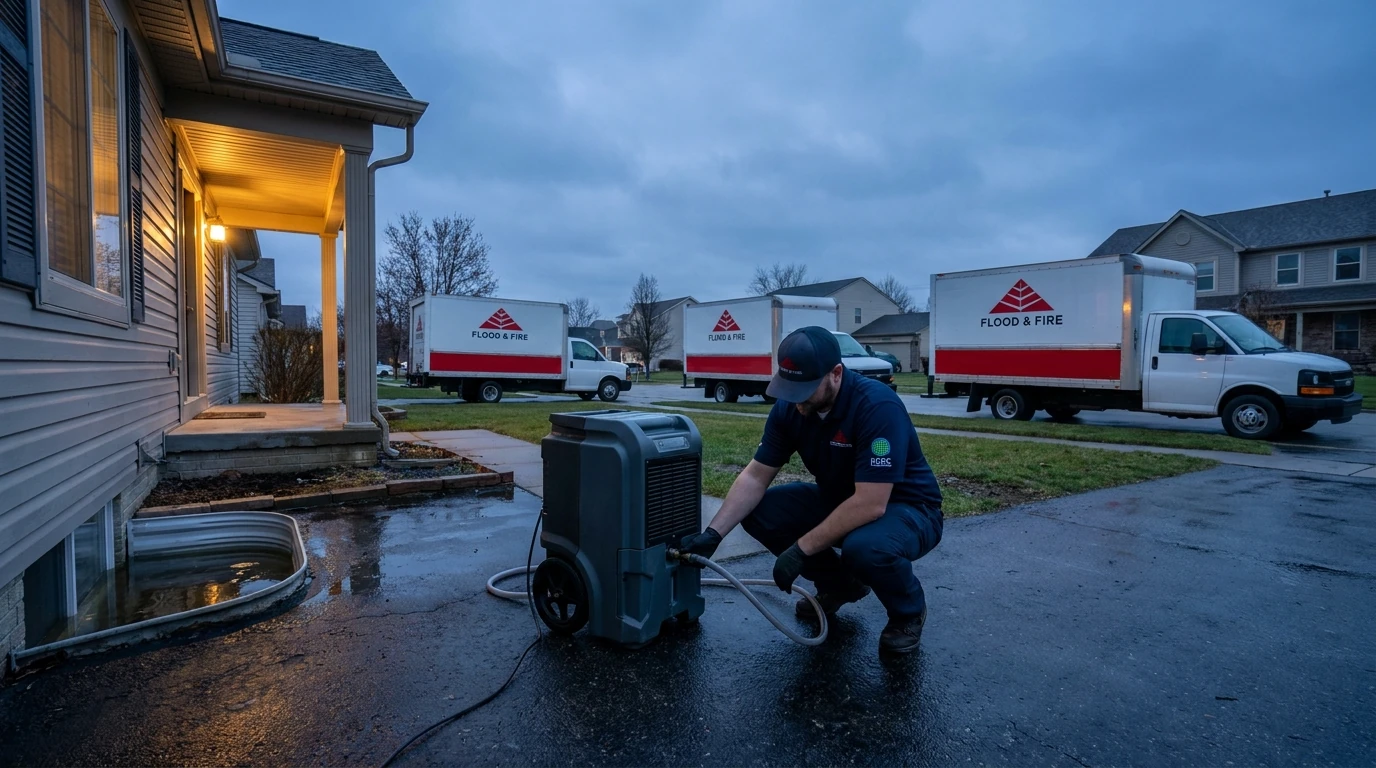
- Extraction. Standing water is removed with truck-mounted or portable extractors. Wet carpet and pad are typically pulled at this stage.
- Demolition. Unsalvageable materials (wet drywall below the flood line, saturated insulation) are removed and bagged for disposal.
- Drying setup. LGR dehumidifiers and air movers are placed according to a drying plan. Equipment is monitored daily and adjusted as readings change.
- Antimicrobial application. Treated surfaces are documented with photos and product application records.
- Final moisture verification. When readings reach pre-loss baselines across all affected materials, drying is complete and equipment is removed.
- Reconstruction. Framing, drywall, insulation, flooring, and finishes are restored to pre-loss condition.
For a detailed timeline on how long each phase takes, see How Long Does Water Damage Restoration Actually Take?
What Should You Do Right Now?
If you have standing water or a recent water event in your Macomb home, the most important thing you can do is start extraction as fast as possible. Every hour matters for cost and for mold risk.
Document everything before anything is moved: photos and video of standing water, affected materials, and the source of the loss. Your insurance adjuster will need this. Call your insurer to open a claim, but you do not need to wait for an adjuster to arrive before mitigation begins, most policies require prompt action to prevent further damage.
For a written scope and real pricing for your specific loss, contact Flood Solutions inc at (586) 580-0197. They have served Macomb and surrounding Macomb County communities since 1996, are licensed and insured, and provide a written scope of work before any work begins.
About Flood Solutions inc
Flood Solutions inc is a locally owned and operated water damage restoration company serving Macomb, Sterling Heights, Warren, Clinton Township, Troy, Rochester Hills, Shelby Township, Utica, and Chesterfield, MI. Founded in 1996 and licensed and insured in Michigan, their crews handle water damage restoration and water cleanup for residential and commercial properties across Macomb County and the surrounding region. Every job starts with a written scope of work, no surprises on the final invoice.
Video Transcript
You just found standing water in your Macomb home. Before the panic sets in, let’s talk real numbers, what water damage restoration actually costs here. Most Macomb homeowners pay between $1,800 and $12,000. A single room with clean water typically runs $1,500 to $4,000. A finished basement flooded with contaminated water? That can reach $15,000 or more. The range is wide because every loss is different. The biggest cost driver is water category. Clean water from a pipe is far cheaper to remediate than gray or black water from sewage backup. Speed matters enormously. Every hour water sits, it migrates further into walls, floors, and insulation, pushing your costs higher. First comes extraction, industrial pumps pulling standing water out fast. Then commercial dehumidifiers and air movers run for three to five days. Wet drywall and insulation that can’t be dried must be removed. Leaving wet material behind is how mold starts within 24 to 48 hours. After drying, surfaces get antimicrobial treatment. Then reconstruction begins, new drywall, flooring, trim, and paint bringing the space back to normal. Your insurance adjuster expects a written scope with line items for each phase. Always get a detailed written estimate before any work begins. Get the full cost breakdown at floodsolutionsinc.com. Call Flood Solutions Inc at (586) 580-0197 for a free estimate today.