
Emergency Ceiling Water Damage Repair in Macomb
Emergency ceiling water damage repair in Macomb and surrounding areas. Insurance billing accepted. Call (586) 580-0197.
Water coming through the ceiling in Macomb? Call now for emergency service. Our crew responds fast to stop the leak damage and start drying.
A bubble forming in your drywall ceiling is not just cosmetic. Within 24 to 48 hours of water pooling above a ceiling surface, gypsum board begins to swell, joint compound softens, and the weight of absorbed water can cause a section to collapse without warning. Whether the source is a burst pipe in the floor above, a roof leak that tracked along a rafter, or an overflowed upstairs bathroom, the ceiling is often where the damage becomes visible long after the water has already spread laterally through insulation and framing. Getting that ceiling assessed and dried correctly is what prevents a contained incident from becoming a structural repair.
What ceiling water damage repair actually involves
Ceiling water damage repair is not a single task. It is a sequenced process that starts with finding the water source, moves through structural drying, and ends with finished surface restoration. The visible stain or sag is almost always the last place the water arrived, which means the repair scope extends above the ceiling plane into the cavity where insulation, joists, and subfloor or roof sheathing live.
Water-stained drywall that feels dry to the touch can still read elevated moisture on a calibrated pin or pinless meter. Gypsum is porous, and the paper face holds moisture longer than the core. Insulation above the ceiling, especially fiberglass batt, can hold water for days while appearing undisturbed from below. A sagging ceiling water damage situation is a sign that the gypsum has been saturated long enough to lose structural integrity, and that section typically cannot be dried in place.
Equipment used in ceiling drying includes low-grain refrigerant (LGR) dehumidifiers, axial and centrifugal air movers positioned to create cross-flow drying patterns, and in some cases, injection drying systems that push conditioned air directly into the ceiling cavity through small access holes rather than requiring full demolition.
Our process
-
Source identification and stop. Before any drying equipment is placed, the water source is located and confirmed stopped. A ceiling leaking from a slow roof penetration behaves differently than one fed by a pressurized supply line. If the source is still active, drying is ineffective.
-
Moisture mapping. Technicians use thermal imaging and calibrated moisture meters to trace the full extent of saturation above and around the visible damage. This step defines the actual drying zone, which is almost always larger than the stain or sag visible from the room below.
-
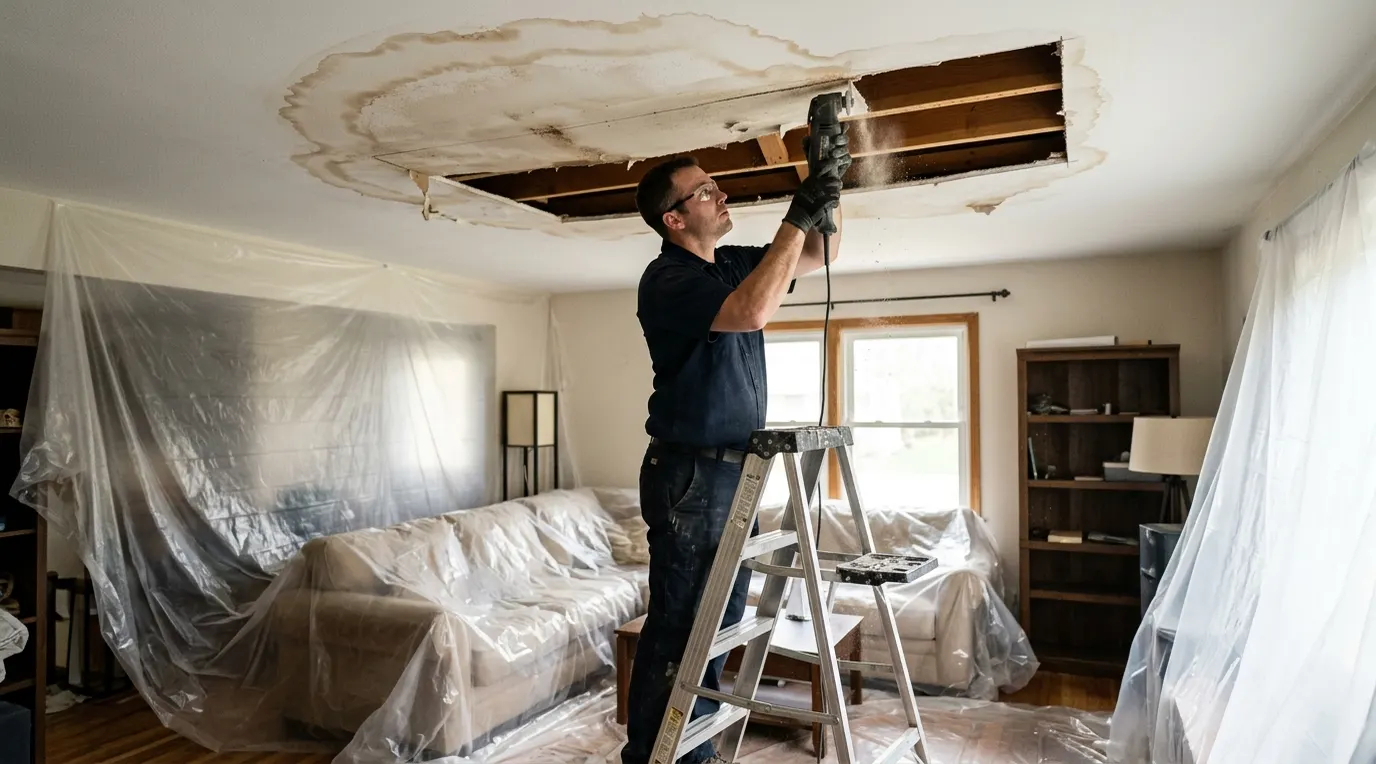
Controlled demolition where necessary. Sections of ceiling drywall that have lost structural integrity or that block airflow to saturated cavities are removed. This is not cosmetic damage; it is a required step to dry the assembly. Insulation that has absorbed water is removed and bagged, as wet insulation does not dry effectively in place and becomes a mold risk within 48 to 72 hours.
-
Structural drying with daily monitoring. Air movers and dehumidifiers are set to dry the exposed framing and remaining materials to documented moisture targets. Readings are logged daily. Drying is not complete until the framing and adjacent materials reach equilibrium with pre-loss moisture content, not just when the surface feels dry.
-
Ceiling restoration. Once the structure passes moisture clearance, drywall is replaced, taped, mudded, and textured to match the existing ceiling. Water stains on salvageable surfaces are sealed with a stain-blocking primer before paint. The finished ceiling should not show the event.
What separates a good ceiling water damage response from a bad one
The most common mistake in ceiling water damage repair is treating the visible stain as the boundary of the loss. Water coming through a ceiling has typically traveled horizontally before it dropped, meaning adjacent rooms, wall cavities, and the subfloor above may all be involved. Operators who limit their moisture mapping to the stained area routinely miss saturation that later produces mold growth behind intact drywall.
A second common failure is skipping daily moisture logs. Insurance adjusters reviewing a claim for ceiling water damage repair look for documented drying progress: dated moisture readings at mapped locations, equipment placement records, and a clear endpoint where readings confirmed the structure was dry. Without that documentation, a carrier has grounds to dispute whether drying was necessary or complete.
On older Macomb-area homes built before the 1980s, ceilings may be plaster over wood lath rather than drywall. Plaster dries much more slowly, holds moisture in the lath for extended periods, and requires different drying strategies. Assuming a ceiling is drywall without confirming the construction type leads to under-powered drying setups and extended timelines.
What does ceiling water damage repair cost?
Typical costs for ceiling water damage repair vary based on the size of the affected area, the water category, whether insulation and framing are involved, and how much ceiling surface requires replacement and refinishing. Most homeowners pay somewhere in the range below, based on industry-typical figures.
| Scenario | Typical range |
|---|---|
| Single room, clean water, surface stain only | $800 - $2,500 |
| Single room, clean water, drywall replacement required | $1,500 - $4,000 |
| Multiple rooms or hallway, ceiling cavity involved | $3,000 - $7,500 |
| Insulation removal and replacement included | Add $500 - $2,000 |
| Plaster ceiling repair (older construction) | $2,000 - $6,000+ |
| Category 2 or 3 water source (gray or black water) | Add 30-60% to above ranges |
Every loss is different, and Flood Solutions inc provides a written scope of work before any repair begins. Homeowners insurance typically covers sudden and accidental water damage to ceilings, including drying, demolition of unsalvageable materials, and surface restoration, but coverage depends on the source of the loss and your specific policy terms.
Seasonal and regional considerations
In Macomb County, ceiling leaks cluster around two seasonal windows. Late winter and early spring bring ice dam conditions on homes with lower-slope rooflines, where snowmelt backs up under shingles and enters through the roof deck. A ceiling water stain that appears in February or March with no interior plumbing source overhead is ice dam activity until proven otherwise. The second window is summer storm season, when wind-driven rain finds gaps around roof penetrations, skylights, and chimney flashings that may have shifted through freeze-thaw cycles over the winter.
Macomb County’s clay-heavy soils also affect homes with flat or low-slope roof sections, where poor drainage can allow standing water to find seams. Homes built in the post-war expansion of the county through the 1950s and 1960s often have original roof flashings that have exceeded their service life.
Service area
Flood Solutions inc serves Macomb and the surrounding communities throughout Macomb County, including Sterling Heights, Clinton Township, Shelby Township, Warren, Chesterfield, and St. Clair Shores. The city and county service pages link back here for the full description of what ceiling water damage repair involves.
If you are looking at a water stain, a bubble, or a sagging section of ceiling right now, call Flood Solutions inc at (586) 580-0197. The longer saturated materials sit, the wider the drying scope becomes. A moisture assessment now is the fastest way to know what you are actually dealing with.
Services We Handle
- Roof Leak Water Damage
Frequently Asked Questions
Does homeowners insurance cover ceiling water damage repair?
My ceiling is bulging but hasn't collapsed yet. Should I puncture it to release the water?
The ceiling feels dry now. Does it still need professional drying?
How long does it typically take to dry a ceiling after water damage?
What is the difference between a water stain ceiling repair and a full ceiling water damage repair?
Looking for the best ceiling water damage repair company in Macomb?
Flood Solutions inc provides ceiling water damage repair in Macomb, MI and the surrounding area, and has served local property owners since 1996. Customers rate us 4.4 out of 5 stars across 35 Google reviews. We answer calls 24/7 — call (586) 580-0197 for immediate help.
Need Ceiling Water Damage Repair now?
We respond 24/7 across Macomb and surrounding MI cities.
Related Coverage
- Our Restoration Services
- Contact Flood & Fire Solutions
- Emergency Ceiling Water Damage Repair in Chesterfield
- Emergency Ceiling Water Damage Repair in Clinton Township
- Emergency Ceiling Water Damage Repair in Rochester Hills
- Emergency Ceiling Water Damage Repair in Shelby Township
- Emergency Ceiling Water Damage Repair in Sterling Heights
- Emergency Ceiling Water Damage Repair in Troy
- Emergency Ceiling Water Damage Repair in Utica
- Emergency Ceiling Water Damage Repair in Warren