Commercial Restoration in Macomb
Commercial restoration in Macomb and surrounding areas. Insurance billing accepted. Call (586) 580-0197.
When a business loses time, every hour matters
A burst pipe at 2 a.m. soaks your server room. A kitchen fire leaves soot on every surface of your retail space. A sewer backup shuts down your office building before the morning shift arrives. Commercial losses hit differently than residential ones: you have tenants, employees, inventory, liability, and a lease clock running while the damage sits. Commercial restoration is the discipline of stopping that clock, documenting the loss completely, and returning a working property to operation as fast as the building allows.
What commercial restoration actually involves
Commercial restoration covers the full range of structural and contents damage that affects businesses, multi-unit buildings, office parks, retail centers, and industrial properties. The work is technically the same as residential restoration in many respects, but the scale, the stakeholders, and the documentation requirements are different in almost every way.
A commercial water loss in a mid-rise office building may involve dozens of affected suites, multiple insurance policies, a property manager, individual tenants, and a building engineer who controls mechanical access. A commercial fire in a restaurant chain location may require coordinating with a franchise operations team while also managing structural repairs, hood suppression system documentation, and health department re-inspection before the doors reopen.
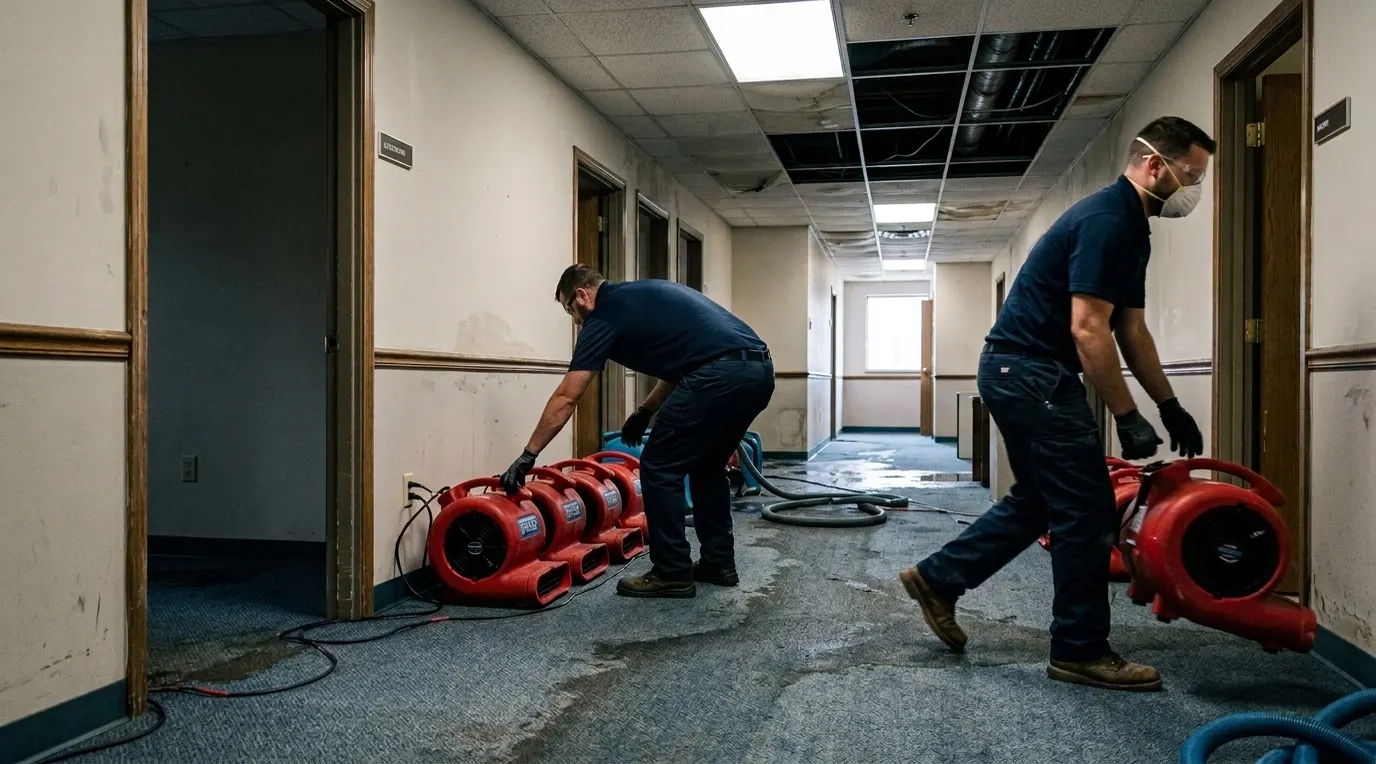
Equipment deployed on commercial jobs scales accordingly: large-capacity truck-mount extractors for standing water, industrial desiccant dehumidifiers for high-volume spaces, negative-air machines and poly containment barriers for mold or smoke work, and thermal imaging cameras to locate moisture migration inside walls and above drop ceilings before it becomes a secondary claim.
Timeline depends entirely on loss type and scope. Commercial water damage drying typically runs 3 to 5 days for a contained single-floor loss, longer for multi-floor saturation or Category 2 and 3 contamination. Fire and smoke remediation in a commercial kitchen or retail space can run 1 to 3 weeks depending on soot type and substrate penetration. Reconstruction phases follow once the structure is clean and dry.
Our process
-
Loss assessment and scope documentation. Before any equipment moves, the affected area is walked, photographed, and measured. Moisture readings are taken at the floor, wall cavity, and ceiling plane. For fire losses, soot type is characterized (dry, wet, or protein-based) because each requires a different chemical approach. This documentation becomes the foundation of the insurance claim and the written scope of work.
-
Containment and access control. On commercial sites, unaffected areas of the building must stay operational where possible. Poly containment barriers, negative-air pressure zones, and clearly marked work corridors protect tenants and employees from cross-contamination while the restoration team works. For mold or Category 3 water losses, containment is a regulatory and liability requirement, not optional.
-
Extraction, debris removal, and initial drying setup. Standing water is extracted, saturated materials that cannot be saved are removed and documented for the adjuster, and the drying equipment is staged. Dehumidifiers and air movers are positioned based on the psychrometric conditions of the space, not just placed in a grid. Commercial spaces with concrete slab floors, drop ceilings, and metal stud framing require different drying strategies than wood-framed residential construction.
-
Daily monitoring and moisture mapping. Drying is not a set-it-and-forget-it process. Readings are taken each day, logged, and compared against the previous day’s baseline. Equipment is repositioned as moisture migrates. This daily record is what an adjuster needs to approve the drying phase of a claim, and it is what protects the property owner if secondary damage appears later.
-
Clearance, rebuild scope, and handoff. Once the structure meets drying standards, a final moisture map is produced and the reconstruction scope is written. For mold losses, post-remediation air sampling confirms clearance before containment comes down. The property is then ready for the rebuild phase, whether that means patching drywall in a single office or a full floor-by-floor reconstruction.
What separates a good commercial restoration response from a bad one
The most common failure in commercial restoration is treating a large loss like a scaled-up residential job. It is not. A contractor who places residential-grade dehumidifiers in a 20,000-square-foot warehouse and checks back in three days is not running a commercial restoration, they are running a residential process in a bigger building.
Specific things that go wrong on commercial losses:
- Missed moisture in concrete and masonry. Concrete reads dry at the surface long before it is actually dry at depth. Contractors who rely only on surface readings miss trapped moisture that feeds mold growth weeks after the job closes.
- Inadequate documentation for multi-party claims. Commercial losses often involve a building owner’s policy, a tenant’s business interruption policy, and sometimes a separate equipment floater. Each carrier needs its own documentation package. Gaps in the photo log or moisture readings create claim disputes that delay payment and reconstruction.
- Soot mischaracterization on fire losses. Protein soot from a commercial kitchen fire is nearly invisible but penetrates porous surfaces deeply and produces a persistent odor that dry-cleaning methods will not remove. Treating it like dry carbon soot from a structural fire leads to callbacks and incomplete remediation.
- Failure to coordinate with building systems. HVAC systems in commercial buildings distribute smoke, soot, and mold spores throughout a structure. Restoration that does not include an HVAC inspection and cleaning scope leaves a contamination pathway open.
What does commercial restoration cost?
Typical costs for commercial restoration vary widely based on loss type, building size, occupancy type, and how quickly mitigation begins. The ranges below reflect industry-typical figures for commercial losses and are not quotes from Flood Solutions inc.
| Scenario | Typical range |
|---|---|
| Single-office water loss, clean water source | $2,500 to $6,000 |
| Multi-suite water loss, one floor | $8,000 to $25,000 |
| Commercial fire, kitchen or single tenant space | $15,000 to $60,000 |
| Mold remediation, commercial HVAC or server room | $5,000 to $20,000 |
| Category 3 (sewage) loss, retail or office | $10,000 to $35,000 |
| Full floor reconstruction following major water or fire loss | $40,000 to $150,000+ |
Every commercial loss is different, and Flood Solutions inc provides a written scope of work before any restoration begins. Commercial property insurance typically covers sudden and accidental losses including water damage from burst pipes, fire and smoke damage, and storm-related intrusion, though policy terms, deductibles, and business interruption provisions vary significantly by carrier and lease structure.
Seasonal and regional considerations
Macomb County’s climate creates predictable commercial loss patterns that property managers and building owners see year after year. Hard freezes in January and February split copper supply lines in exterior walls and unheated utility spaces, particularly in older commercial strip centers and industrial buildings constructed before modern insulation standards. Spring snowmelt combined with clay-heavy soils across much of the county creates hydrostatic pressure against foundation walls and below-grade parking structures. Summer humidity in the low-lying areas near the Clinton River corridor keeps interior relative humidity elevated enough that HVAC systems running at reduced capacity during off-hours can allow mold colonization behind wall cavities within days of a water intrusion. Fall brings the first hard freeze risk back into the picture for any building that reduced heating during the shoulder season.
Buildings constructed in Macomb County during the post-war commercial boom of the 1950s through 1970s often have flat or low-slope roofs with aging membrane systems, cast-iron drain lines prone to root intrusion, and original single-pane storefront glazing that creates condensation problems in winter. These construction characteristics show up repeatedly in commercial water and mold claims across the county.
Service area
Flood Solutions inc is based in Macomb, MI and provides commercial restoration throughout Macomb County and the surrounding region, including Sterling Heights, Clinton Township, Shelby Township, Chesterfield, Warren, St. Clair Shores, and New Baltimore. Specific service-area pages for commercial restoration in each city are linked from this page and go into local detail for each market.
If your property is in Macomb County or the surrounding area and you are looking at active damage right now, call (586) 580-0197 to speak with someone who can begin the documentation and mitigation process.
Services We Handle
- Building Restoration
- Commercial Building
- Commercial Damage Recovery
Frequently Asked Questions
Does commercial property insurance cover water damage, fire damage, and mold from a sudden loss?
How do you keep the rest of my building operational while restoration work is happening?
What is the difference between Category 1, 2, and 3 water damage, and why does it change the restoration process for a commercial building?
How does smoke and soot behave differently in a large commercial space compared to a house, and what does that mean for cleanup?
What documentation should I expect from a commercial restoration contractor, and why does it matter for my insurance claim?
Looking for the best commercial restoration company in Macomb?
Flood Solutions inc provides commercial restoration in Macomb, MI and the surrounding area, and has served local property owners since 1996. Customers rate us 4.4 out of 5 stars across 35 Google reviews. We answer calls 24/7 — call (586) 580-0197 for immediate help.
Need Commercial Restoration now?
We respond 24/7 across Macomb and surrounding MI cities.
Related Coverage
- Our Restoration Services
- Contact Flood & Fire Solutions
- Commercial Restoration in Chesterfield
- Commercial Restoration in Clinton Township
- Commercial Restoration in Rochester Hills
- Commercial Restoration in Shelby Township
- Commercial Restoration in Sterling Heights
- Commercial Restoration in Troy
- Commercial Restoration in Utica
- Commercial Restoration in Warren