
Mold Inspection and Testing in Clinton Township
Mold inspection and testing in Clinton Township, MI. Insurance billing accepted. Call (586) 580-0197.
Our technicians are dispatched from our Macomb, MI headquarters and are typically on-site in Clinton Township within 60 minutes of your call.
Clinton Township sits in Macomb County where the Great Lakes climate delivers humid summers, freeze-thaw winters, and enough seasonal moisture to keep crawl spaces and basements working against homeowners year-round. When a slow pipe drip, a backed-up sump, or a poorly sealed rim joist lets that moisture in, mold can begin colonizing porous materials within 24 to 48 hours. Because mold growth is often invisible behind drywall or under subfloor sheathing long before it becomes a smell or a stain, a professional mold inspection and testing assessment is frequently the only way to know what you are actually dealing with.
Why Clinton Township Properties See Mold Issues
Macomb County’s clay-heavy soil drains slowly, which means water pools against foundation walls after heavy rain rather than percolating away. Clinton Township’s housing stock includes a large share of ranch-style and split-level homes built between the late 1950s and the 1980s, many with block or poured concrete basements that were not built to today’s moisture-barrier standards. Older fiberglass batt insulation in rim joist cavities absorbs condensation and holds it against wood framing, creating a low-visibility mold environment that a surface check will miss entirely.
The township’s proximity to Lake St. Clair also plays a role. Summer dew points regularly climb into the uncomfortable range, and when air-conditioned interior air meets an under-insulated basement wall, the condensation that forms is enough to sustain mold colonies without any active leak at all.
Our Mold Inspection and Testing Process in Clinton Township
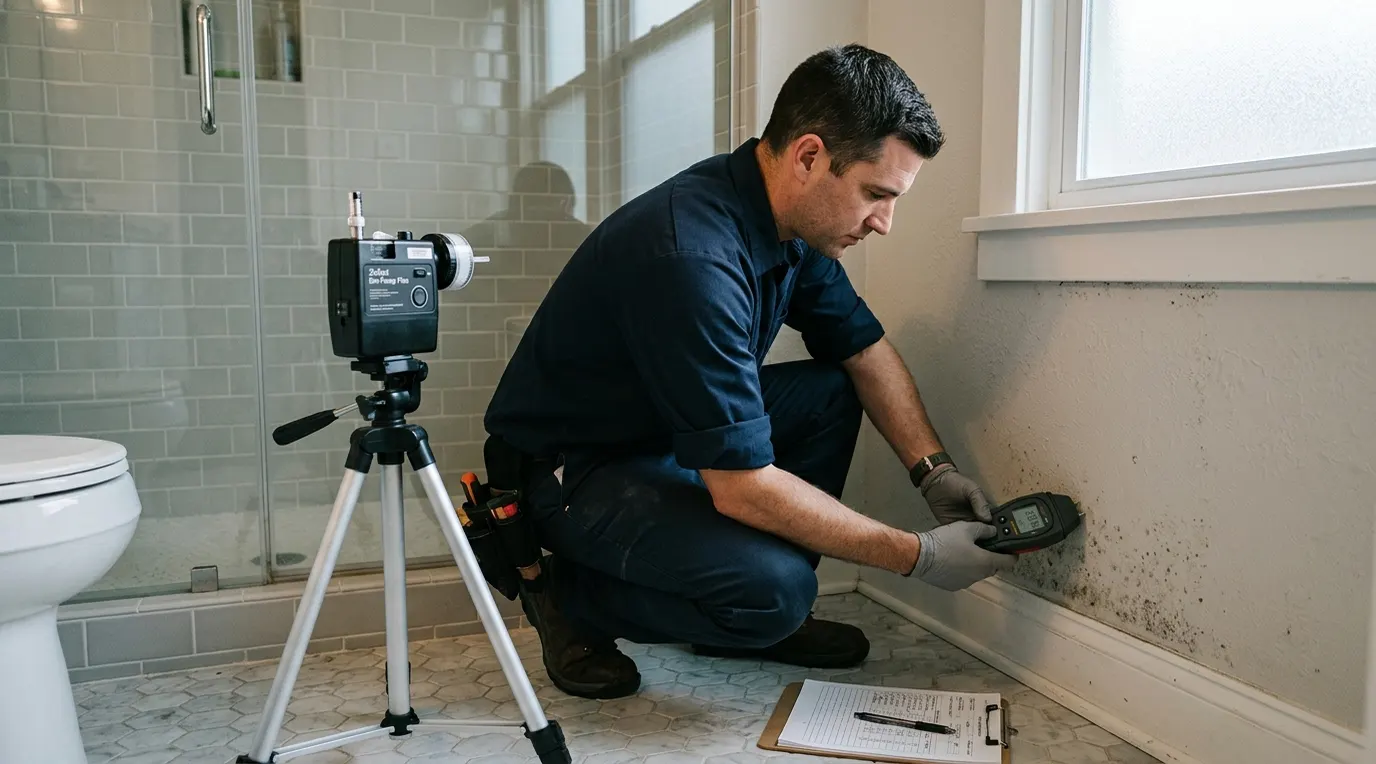
A mold assessment is not a single swab and a report. The process starts with a visual inspection of the areas most likely to harbor hidden moisture: basement walls, crawl space framing, attic sheathing, bathroom exhaust pathways, and any area with a history of water intrusion. Moisture meters and thermal imaging help identify wet zones behind finished surfaces without tearing into walls unnecessarily.
From there, air sampling captures what is actually circulating through the living space. Spore trap cassettes are pulled from multiple locations inside the home and compared against an outdoor baseline sample. That comparison matters because mold spores exist everywhere outdoors; the question is whether indoor concentrations and species profiles deviate from what is normal for the season. Samples are sent to an accredited third-party laboratory, and the written report details species identified, spore counts by room, and whether findings support a remediation recommendation.
Surface sampling, tape lifts, or bulk material samples are added when a specific stained or suspect area needs direct identification. The goal is a documented picture of the property’s indoor air quality that you can share with your physician, your insurance adjuster, or a remediation contractor.
Equipment and Methods We Use for Mold Testing
Air-O-Cell spore trap cassettes are the industry standard for indoor air quality testing because they capture both viable and non-viable spores, giving the lab a complete picture rather than only what happens to grow in culture. Moisture mapping with a pin-type and pinless meter combination lets the technician log readings across a grid of the affected area, producing a moisture map that shows where the problem is worst and where it has already dried.
Thermal imaging is particularly useful in Clinton Township’s older ranch homes where finished basement ceilings hide rim joist framing. A temperature differential between a wet framing cavity and surrounding drywall shows up clearly on a thermal camera even when the surface looks dry and painted.
Clinton Township Insurance and Documentation
Mold testing reports are frequently requested by homeowners insurance carriers before a remediation claim is approved, and by buyers and sellers during real estate transactions. The written laboratory report and the moisture map together give an adjuster the documentation needed to evaluate a claim without a second site visit. If remediation follows, a post-remediation verification test provides the clearance documentation that confirms the work is complete.
Local Note
Clinton Township homes built in the 1960s and 1970s often used a combination of concrete block basement walls and wood-paneled interior finishing. The gap between the block and the paneling creates a hidden channel where moisture migrates upward from the footing and condenses on the back of the wood. By the time a musty smell is noticeable in the living space above, the framing cavity behind those panels can already show significant colonization. Inspectors working in this area learn to probe that wall assembly specifically, because a moisture reading taken only at the panel face will almost always read dry.
If you are noticing a persistent musty odor in your Clinton Township home or have had any water event in the past year, call Flood Solutions at (586) 580-0197 to schedule a mold inspection and testing appointment. A documented assessment gives you facts instead of guesswork, and that is the right starting point whether remediation follows or not.
Serving Clinton Township from our Macomb headquarters — ★ 4.4 · 35 Google reviews
“Such a great experience this team was so helpful. Got my basement cleaned up and made sure there was no damage to the walls or anything else. They handled everything so fast.” — Danielle, October 2025Read our reviews on Google →
Mold Inspection and Testing in Clinton Township: Service Coverage
Frequently Asked Questions
How fast can you arrive for mold inspection and testing in Clinton Township?
How does Clinton Township's clay soil affect mold risk in my basement?
What does a mold inspection in Clinton Township actually include?
Are older ranch-style homes in Clinton Township more prone to mold problems than newer construction?
Will my homeowners insurance in Michigan cover mold testing costs?
How long does it take to get mold test results for a Clinton Township property?
Mold Inspection and Testing response in Clinton Township
Most Clinton Township calls see a technician on-site within 60 minutes from our Macomb headquarters.