Mold Inspection and Testing in Macomb
Mold inspection and testing in Macomb and surrounding areas. Insurance billing accepted. Call (586) 580-0197.
You smell something musty in the basement after last spring’s flooding, or you notice a dark stain spreading along the drywall seam behind the washing machine. The surface looks contained, but mold colonies can establish within 24 to 48 hours of moisture exposure, and what is visible is often a fraction of what is actually growing. Mold inspection and testing answers the question that remediation alone cannot: what is in the air, where exactly is the growth, and how far has it spread behind surfaces you cannot see?
What mold inspection and testing actually involves
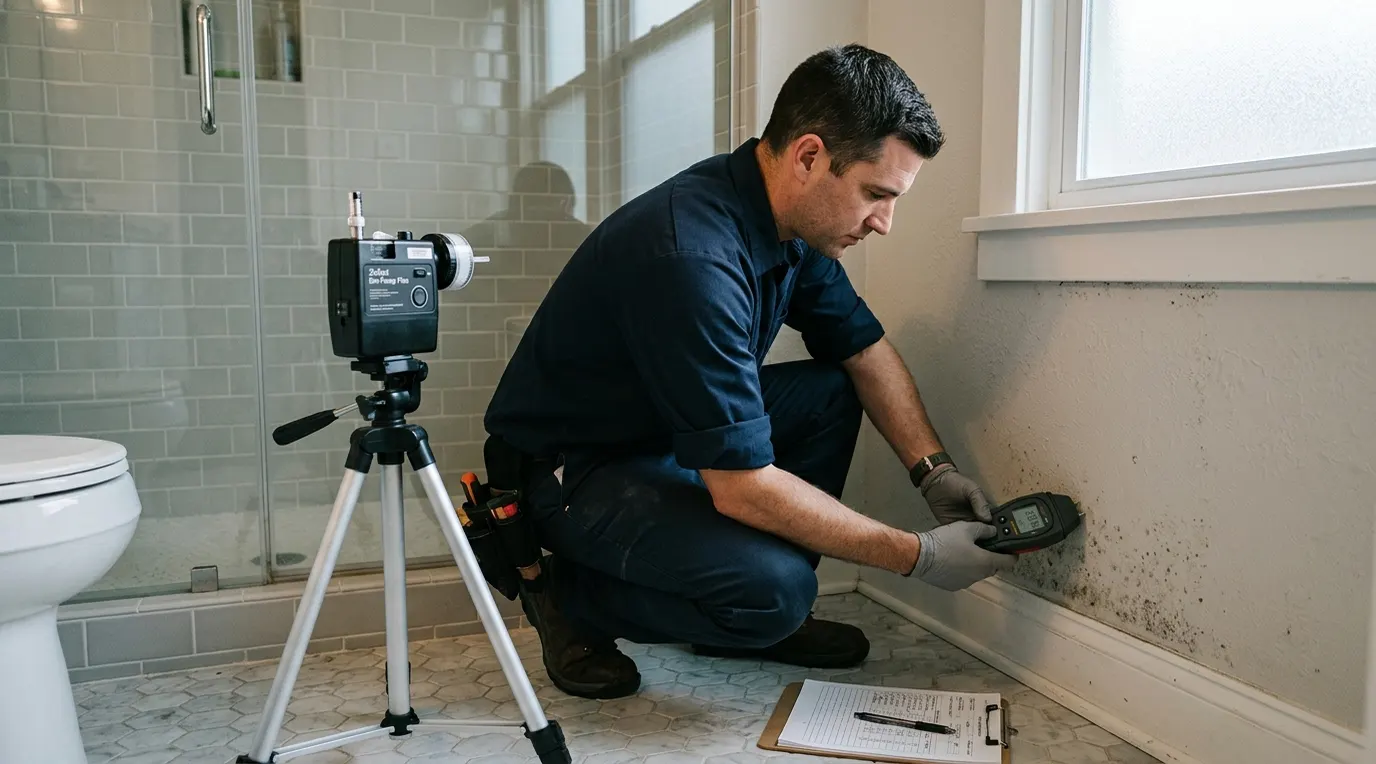
A mold inspection is not a visual walkthrough with a flashlight. A thorough mold assessment combines moisture mapping, surface sampling, and air quality testing to build a complete picture of contamination. Inspectors use calibrated moisture meters and thermal imaging cameras to identify elevated moisture readings behind walls, under flooring, and inside ceiling cavities where mold can colonize without any visible sign on the surface.
Mold spore testing captures what is actually circulating in your breathing air. Air samples are drawn through a calibrated pump into spore trap cassettes, then sent to an accredited third-party laboratory. Results identify the genera of mold present, the spore concentration per cubic meter, and how indoor counts compare to an outdoor baseline sample taken the same day. That comparison matters: elevated indoor counts relative to outdoor levels indicate an active interior source, even when no visible growth is found.
Surface or bulk samples may also be collected from suspect materials, tape-lifted from staining, or cut from drywall or insulation. These confirm what species are present at a specific location and inform the remediation scope.
The full process typically takes two to four hours on-site, with laboratory results returned within three to five business days depending on the lab’s turnaround option selected.
Our process
-
Initial walkthrough and moisture mapping. The inspection begins with a systematic room-by-room assessment using a moisture meter and, where conditions warrant, a thermal imaging camera. Every reading above the baseline threshold is logged and photographed. Plumbing chases, HVAC air handlers, crawlspaces, and attic decking are included, not just the area of visible concern.
-
Outdoor baseline air sample collection. Before any indoor samples are taken, an outdoor spore trap cassette is collected near the structure. This baseline is essential for interpreting indoor results accurately. Without it, laboratory data is difficult to contextualize.
-
Indoor air sampling by zone. Spore trap cassettes are collected in each affected area and in at least one unaffected area of the home for comparison. Sample locations are documented with photographs and GPS-tagged floor plan notes so the laboratory report is tied directly to specific rooms.
-
Surface or bulk sampling where indicated. Visible staining, discoloration, or suspect material identified during moisture mapping is sampled via tape lift or bulk collection. This step confirms whether a surface stain is mold and, if so, what genus, which affects the remediation protocol required.
-
Written assessment and findings report. After laboratory results are received, a written mold assessment report is prepared. It includes the moisture map, sample locations, lab data, a summary of findings, and a recommended scope of work if remediation is warranted. This report is formatted to be submitted directly to your insurance carrier or used by a licensed remediator to build a remediation plan.
What separates a good mold inspection from a bad one
The most common failure in mold testing is skipping the outdoor baseline. Without it, a laboratory report showing 800 spores per cubic meter of Cladosporium indoors is nearly meaningless. If outdoor counts that day are also 750, there is no meaningful indoor amplification. If outdoor counts are 120, that same number signals a significant interior source. Inspectors who skip the baseline are cutting corners that directly affect the accuracy of your results.
A second common problem is single-point sampling. One air sample pulled from the center of a finished basement does not tell you whether the elevated reading is coming from the HVAC return, the wall cavity behind the sump pit, or the ceiling above a finished drop tile. Multi-zone sampling with documented locations is what produces an actionable report.
Insurance adjusters reviewing mold claims look for a few specific things in an inspection report: chain-of-custody documentation for lab samples, the accreditation status of the laboratory used, whether the outdoor baseline was collected the same day as indoor samples, and whether the inspector is independent from the remediator. An inspection report that cannot answer those questions is unlikely to support a successful claim.
Finally, thermal imaging is not a standard inclusion in every inspection. Inspectors who skip it can miss active moisture intrusion behind finished walls that will continue feeding mold growth even after surface remediation is complete.
What does mold inspection and testing cost?
Typical costs for mold inspection and testing vary based on property size, the number of sample locations, and laboratory turnaround time selected. Most homeowners pay somewhere in the following ranges for standard residential inspections:
| Scenario | Typical range |
|---|---|
| Single-room inspection, 1-2 air samples | $200 - $400 |
| Whole-home inspection, 4-6 air samples | $400 - $800 |
| Inspection with thermal imaging added | $500 - $950 |
| Surface or bulk sampling (per sample, lab fees included) | $50 - $150 |
| Rush laboratory turnaround (24-48 hours) | Add $75 - $200 |
| Post-remediation clearance testing | $250 - $500 |
These are typical industry figures and every property is different. Flood Solutions inc provides a written scope before any work begins so you know exactly what is included. Homeowners insurance may cover mold inspection costs when the mold growth is tied to a covered water loss event, such as a burst pipe or appliance leak, though policies vary significantly on mold-specific coverage limits.
Seasonal and regional considerations
Macomb County’s climate creates a specific mold risk window that runs from late spring through early fall. Outdoor humidity regularly climbs above 60 percent from May through September, and when that humid air meets the cooler surfaces inside a basement or crawlspace, condensation forms on block walls, rim joists, and ductwork. This is a different mechanism than a plumbing leak, and it produces a different mold profile, often heavy Penicillium and Aspergillus growth on organic materials like wood framing, cardboard storage boxes, and fiberglass insulation facing.
Many Macomb-area homes were built in the 1960s through 1980s with poured concrete or concrete block basements and minimal vapor barriers. Block walls are particularly prone to seasonal moisture wicking, and the hollow cores of block can harbor mold growth that never becomes visible on the interior surface. Thermal imaging during inspection is especially useful in these construction types.
Winter brings a different risk: ice damming on rooflines can drive water into attic spaces and wall cavities, and because the damage is concealed under insulation, it may not be discovered until the following spring when mold growth is already well established.
Service area
Flood Solutions inc performs mold inspection and testing throughout Macomb County and the surrounding region, including Sterling Heights, Clinton Township, Shelby Township, Warren, Chesterfield, New Baltimore, and St. Clair Shores. Each service-area page links back here for full detail on what the inspection process includes.
Services We Handle
- Mold Inspection
- Mold Testing
Frequently Asked Questions
Does homeowners insurance cover mold inspection and testing?
What is the difference between air sampling and surface sampling, and do I need both?
Why does the inspector need to collect an outdoor air sample on the same day?
Can mold be present even if I cannot see or smell anything?
What does a post-remediation clearance test involve, and is it different from the initial inspection?
Looking for the best mold inspection and testing company in Macomb?
Flood Solutions inc provides mold inspection and testing in Macomb, MI and the surrounding area, and has served local property owners since 1996. Customers rate us 4.4 out of 5 stars across 35 Google reviews. We answer calls 24/7 — call (586) 580-0197 for immediate help.
Need Mold Inspection and Testing now?
We respond 24/7 across Macomb and surrounding MI cities.
Related Coverage
- Our Restoration Services
- Contact Flood & Fire Solutions
- Mold Inspection and Testing in Chesterfield
- Mold Inspection and Testing in Clinton Township
- Mold Inspection and Testing in Rochester Hills
- Mold Inspection and Testing in Shelby Township
- Mold Inspection and Testing in Sterling Heights
- Mold Inspection and Testing in Troy
- Mold Inspection and Testing in Utica
- Mold Inspection and Testing in Warren
- How To Test for Mold in Your Home (DIY Kits vs a Pro Inspection)