
Mold Inspection and Testing in Utica
Mold inspection and testing in Utica, MI. Insurance billing accepted. Call (586) 580-0197.
Our technicians are dispatched from our Macomb, MI headquarters and are typically on-site in Utica within 60 minutes of your call.
Utica sits in the heart of Macomb County, where clay-heavy soils and a freeze-thaw cycle that can last well into April push groundwater against basement walls season after season. That persistent moisture load, combined with the region’s humid summers, creates conditions where mold can establish itself quietly inside wall cavities and crawl spaces long before a musty odor becomes obvious. Mold inspection and testing in Utica isn’t a precaution you schedule when things look bad; it’s often the step that explains why a room smells off, why allergy symptoms flare indoors, or why a home sale is stalling at the inspection stage.
Why Utica Properties See Elevated Mold Risk
Macomb County’s soil composition is the starting point. The dense clay layer that sits beneath much of Utica drains slowly, which means water from spring snowmelt or a heavy summer storm lingers at the foundation perimeter longer than it would in sandier terrain. Basement walls absorb that hydrostatic pressure gradually, and the moisture that migrates through block or poured concrete doesn’t always announce itself with visible water, it just raises the relative humidity inside the space to the range where mold colonies become viable.
The housing stock adds another layer of complexity. Utica has a meaningful number of homes built in the 1960s and 1970s, a construction era that relied heavily on fiberglass batt insulation tucked between wood framing with limited vapor barriers. That combination holds moisture efficiently and gives mold a ready food source. Older HVAC systems in those homes often lack the dehumidification capacity to compensate during Michigan’s muggy July and August weeks, so spore counts in the indoor air can climb without any single dramatic leak event to point to.
What Mold Inspection and Testing Actually Involves
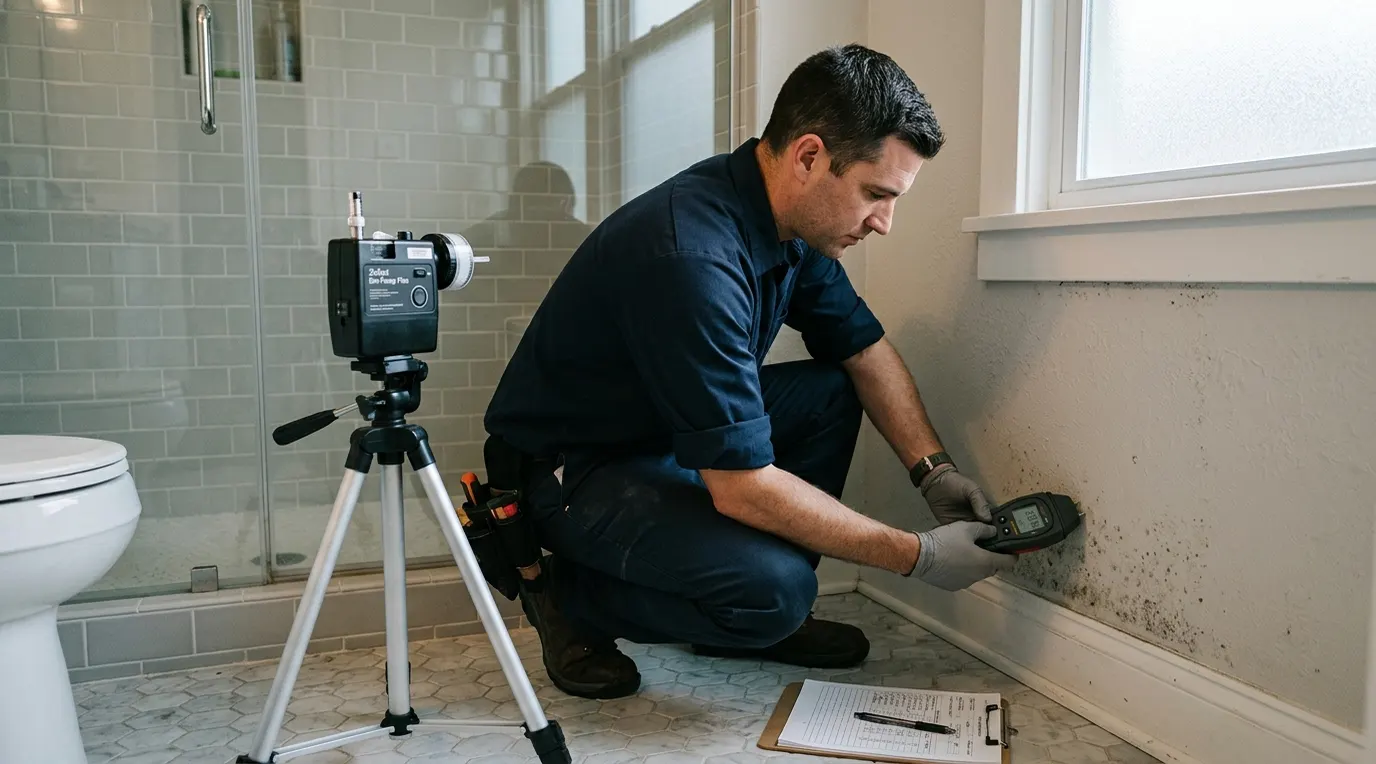
A mold assessment is not a walk-through with a flashlight. The process begins with a visual inspection of areas statistically likely to harbor growth: the rim joist at the top of the foundation wall, the underside of roof sheathing in the attic, bathroom exhaust pathways, and any wall cavity adjacent to a known water intrusion point. Moisture readings with a calibrated meter help identify areas that read dry at the surface but remain elevated behind the finish material.
Air sampling is the step that turns a visual finding into data. A pump draws a measured volume of indoor air through a spore trap cassette, and that cassette goes to an accredited laboratory for analysis. The lab report identifies which genera of mold are present and at what concentration relative to an outdoor control sample taken the same day. That comparison matters: some spore types are common outdoors and unremarkable indoors; others, like Stachybotrys, are rarely found in outdoor air and carry a different weight when they appear in a sample.
Surface sampling, tape lifts or swabs from a visible stain, can confirm whether a discoloration is actually mold growth or something else entirely. Not every dark spot on drywall is a colony, and not every colony is visible. The combination of air and surface data gives a complete picture rather than a guess.
Reaching Utica from Our Macomb Base
Flood Solutions inc has operated out of Macomb since 1996, which puts Utica well within our regular service area. M-59 connects the two communities directly, and Van Dyke Avenue provides an alternate corridor when traffic is heavy. Scheduling is straightforward, call (586) 580-0197 and we will confirm availability and get an inspector on the calendar promptly.
Local Note: What Clay Soil Means for Your Test Results
One thing that becomes clear after years of inspecting homes across Macomb County: outdoor spore counts here tend to run higher during the late summer and early fall than in many other Michigan regions, partly because the clay soil retains organic matter that supports outdoor mold populations. That makes the outdoor control sample in your air test especially important. An indoor reading that looks alarming in isolation may fall within an acceptable ratio once it is compared against what is naturally present outside on the same day. Conversely, a modestly elevated indoor count can still be significant if the outdoor baseline is unusually low. Interpreting the lab report in context, not just reading the raw numbers, is where the assessment adds real value.
If your home is showing signs of moisture intrusion, if a previous water loss was not fully dried, or if you are preparing to list a property and want documentation ahead of a buyer’s inspection, call Flood Solutions inc at (586) 580-0197. We will schedule a thorough mold inspection and testing appointment and give you a clear picture of what the air and surfaces in your Utica home are actually telling you.
Serving Utica from our Macomb headquarters — ★ 4.4 · 35 Google reviews
“Very knowledgeable and friendly employees. I had a flooded crawl space that I couldn't take care of myself. But Louis and his crew talked me through the whole process and then finished the job quickly and thoroughly.” — Chuck, October 2025Read our reviews on Google →
Mold Inspection and Testing in Utica: Service Coverage
Frequently Asked Questions
How fast can you arrive for mold inspection and testing in Utica?
How does Utica's clay soil affect mold risk compared to other parts of Macomb County?
Are the 1960s and 1970s-era homes common in Utica more likely to test positive for mold?
What does the outdoor control sample in an air test tell me about my Utica home's results?
If I am selling a home in Utica, do I need a mold inspection before listing?
What is the difference between mold inspection and mold testing, and do I need both?
Will my homeowners insurance cover mold inspection and testing in Utica?
Mold Inspection and Testing response in Utica
Most Utica calls see a technician on-site within 60 minutes from our Macomb headquarters.