
Water Leak Detection in Clinton Township
Water leak detection in Clinton Township, MI. Insurance billing accepted. Call (586) 580-0197.
Our technicians are dispatched from our Macomb, MI headquarters and are typically on-site in Clinton Township within 60 minutes of your call.
Clinton Township sits on a mix of clay-heavy glacial soils that drain poorly after a hard Michigan rain, and when that ground pressure builds against a slab or foundation wall, even a pinhole supply line failure can stay invisible for weeks. Water leak detection here isn’t simply a matter of turning off valves and listening, it requires reading a home’s behavior in the context of Macomb County’s freeze-thaw cycles, aging copper and galvanized plumbing common in mid-century ranch homes, and a water table that rises noticeably every spring. Flood Solutions Inc has been working these conditions since 1996, and the difference between a fast find and a prolonged search usually comes down to knowing what this ground does to a building.
Why Clinton Township Properties See Hidden Leak Problems
The township’s housing stock tells the story clearly. A significant portion of the residential neighborhoods were built between the late 1950s and early 1980s, when copper supply lines and cast-iron drain stacks were standard. Copper develops pinhole leaks as it ages, especially where water chemistry is slightly acidic, a known characteristic of treated municipal water in this part of Macomb County. Those pinholes can weep inside a wall cavity or beneath a concrete slab for months before a stain appears on drywall or a water bill spikes.
Clay soil compounds the problem. Unlike sandy loam, clay holds moisture against a foundation rather than shedding it. After a wet spring thaw, the kind that comes through reliably in March and April, hydrostatic pressure can push water through hairline cracks in a slab, and that moisture then migrates laterally under flooring. A homeowner notices a soft spot in laminate or a musty smell in a finished basement long after the actual entry point has dried on the surface.
Our Leak Detection Process in Clinton Township
The first step on every job is a pressure test of the supply system. By isolating zones and watching for pressure drop, the crew can confirm whether the leak is in a pressurized supply line or a drain and waste line, two very different problems requiring different tools. For supply leaks, electronic acoustic listening equipment picks up the vibration signature of water escaping under pressure, even through a concrete slab or behind plaster walls.
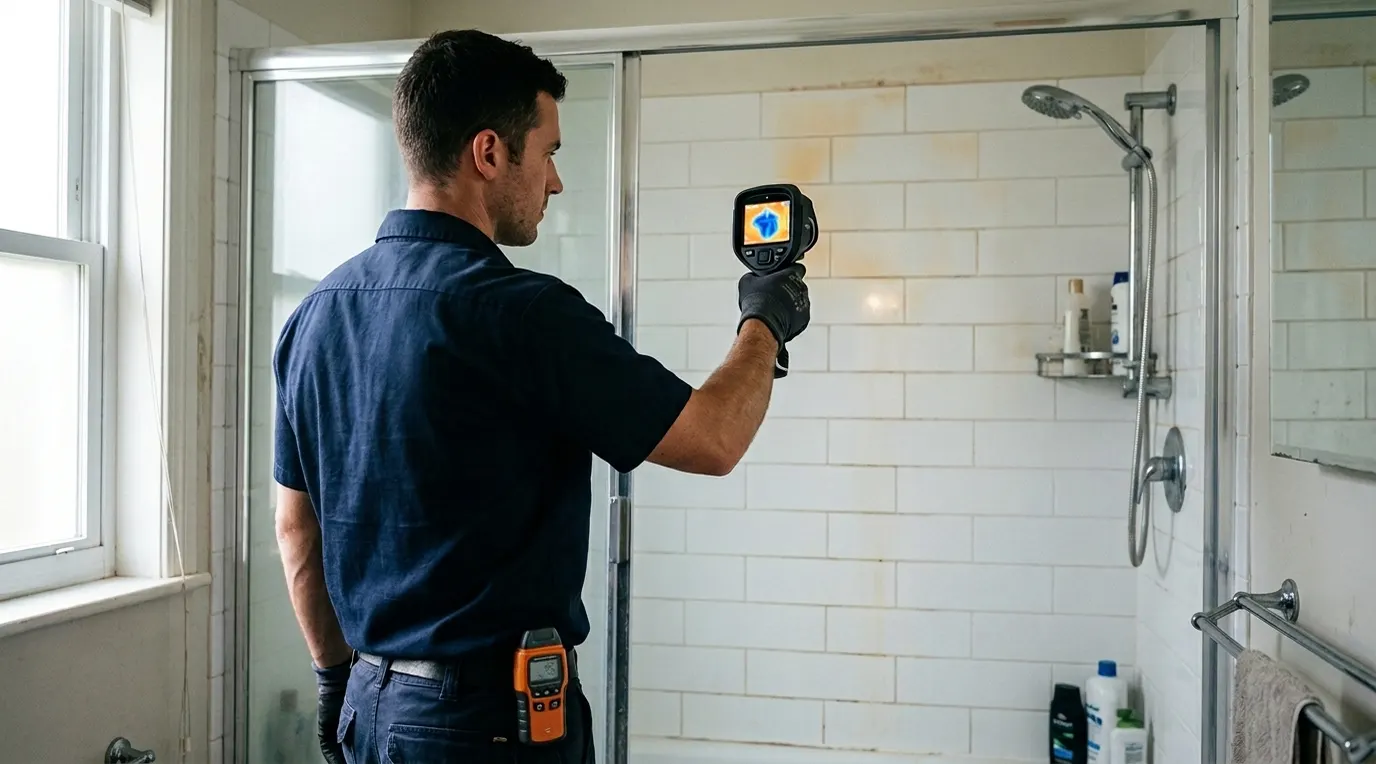
For slab leak detection specifically, thermal imaging cameras add a second layer of confirmation. A slab leak warms or cools the concrete surface in a pattern that’s visible on a thermal scan, giving the technician a precise target before any concrete is touched. In Clinton Township’s older ranch-style homes, where the slab may be 50 or 60 years old and the plumbing was not mapped in any surviving document, this non-invasive step saves significant time and avoids unnecessary demolition.
For water in walls, moisture meters and borescope cameras let the crew trace the migration path without opening every stud bay. The goal is always the smallest access point needed to make the repair, important in finished basements and tiled bathrooms where reconstruction costs add up fast.
Reaching Clinton Township from Macomb
Flood Solutions Inc operates out of Macomb, which puts the crew on Hall Road or Garfield Road and into the township quickly. The routes are straightforward under normal conditions, and the team is familiar with the road network across the township. When you call (586) 580-0197, the dispatcher can give you an honest arrival window based on current conditions rather than a generic promise.
Working with Insurance on a Hidden Leak Claim
Hidden water leak claims are among the more contested in residential property insurance. Carriers often distinguish between sudden and accidental loss, which is typically covered, and long-term seepage, which may not be. The documentation Flood Solutions Inc produces during leak detection, moisture readings, thermal images, pressure test logs, and photographs of the point of failure, is exactly what an adjuster needs to classify the loss correctly. Bringing that evidence to the claim early reduces the back-and-forth that delays repair authorization.
Local Note
One pattern that comes up repeatedly in Clinton Township’s mid-century ranch homes is the location of the main shut-off valve. In homes built before the 1970s, the shut-off is often in a crawl space access point or in a utility room with limited clearance, and it may not have been exercised in years. A valve that hasn’t turned in two decades can fail or refuse to seat fully when you need it most. When the crew arrives for a leak detection call, checking that the shut-off actually functions is part of the initial walkthrough, a small step that prevents a bad situation from becoming a flooded room if a line needs to be opened during testing.
If a hidden water leak is affecting your home in Clinton Township, the longer it goes unlocated, the more material it damages. Call Flood Solutions Inc at (586) 580-0197 to schedule leak detection and get a clear answer on where the water is coming from before the repair work begins.
Serving Clinton Township from our Macomb headquarters — ★ 4.4 · 35 Google reviews
“Such a great experience this team was so helpful. Got my basement cleaned up and made sure there was no damage to the walls or anything else. They handled everything so fast.” — Danielle, October 2025Read our reviews on Google →
Water Leak Detection in Clinton Township: Service Coverage
Frequently Asked Questions
How fast can you arrive for water leak detection in Clinton Township?
How does Clinton Township's clay soil affect slab leak detection compared to other areas?
Are the older ranch-style homes common in Clinton Township more prone to pinhole copper leaks?
What does the leak detection process look like inside a finished Clinton Township basement?
How does the documentation Flood Solutions Inc provides help with an insurance claim in Michigan?
Can a water leak behind a wall in Clinton Township cause mold before it's detected?
Water Leak Detection response in Clinton Township
Most Clinton Township calls see a technician on-site within 60 minutes from our Macomb headquarters.