
Water Leak Detection in Macomb
Water leak detection in Macomb and surrounding areas. Insurance billing accepted. Call (586) 580-0197.
The water you can hear is rarely the water doing the damage
The leak that ruins a subfloor or saturates a wall cavity is almost never the one dripping visibly under a sink. It is the slow seep behind drywall, the pinhole in a copper supply line running beneath a concrete slab, the failing wax ring that has been wicking into the subfloor for months. By the time a homeowner in Macomb notices a soft spot underfoot or a spike on their DTE water bill, the moisture has already traveled. Water leak detection is the process of finding exactly where that water is coming from before any cutting, digging, or demolition begins.
What water leak detection actually involves
Leak detection is diagnostic work, not repair work. The goal is to locate the source of a hidden water leak with enough precision that a plumber or restoration crew can open the minimum amount of material necessary to address it.
The equipment used depends on where the leak is suspected. Thermal imaging cameras read surface temperature differentials that indicate moisture behind walls or under flooring without touching the surface. Acoustic listening devices amplify the sound of water moving under pressure through pipes buried in concrete or behind framing. Moisture meters and pin probes map the spread of saturation in drywall, wood framing, and concrete. For slab leak detection specifically, line-pressure testing can isolate which branch of the plumbing system is losing pressure, narrowing the search area before acoustic equipment is deployed.
A thorough inspection documents not just the leak location but the extent of secondary moisture damage: how far the water has migrated, which materials are saturated, and whether conditions exist that could support mold growth. That documentation matters both for the repair scope and for any insurance claim.
Timeline: a standard leak detection inspection typically takes one to three hours depending on the size of the structure and the complexity of the plumbing layout.
Our process
-
Initial assessment and symptom mapping. Before any equipment comes out, the visible evidence is catalogued: staining patterns, efflorescence on concrete, soft flooring, musty odor zones, and any history the homeowner can provide about when the symptoms appeared. Symptom location often tells you where NOT to look as much as where to start.
-
Pressure testing and system isolation. Supply lines are tested under pressure to confirm a leak is active and to isolate it to a specific branch (hot, cold, irrigation, drain). This step rules out condensation and confirms the loss is from pressurized plumbing rather than a roof or envelope issue.
-
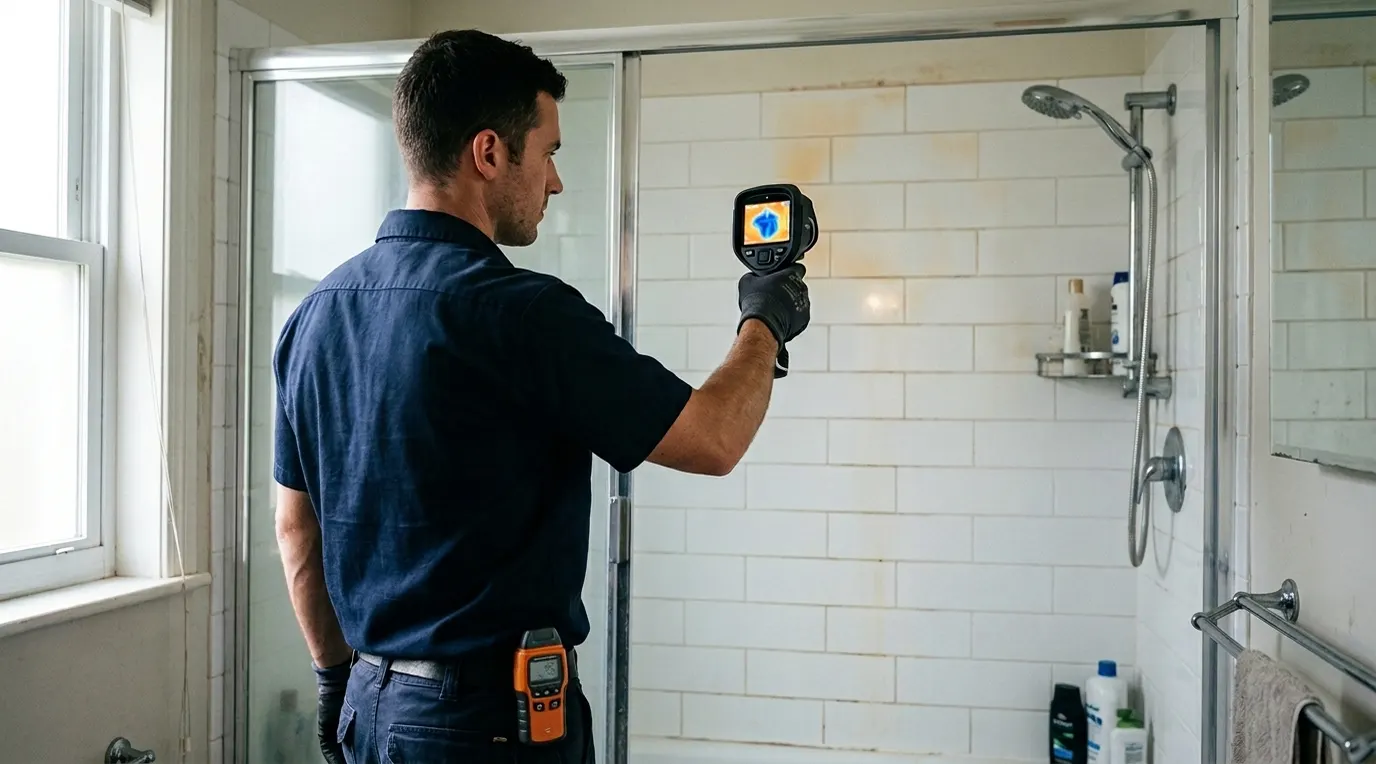
Thermal imaging scan. The affected walls, ceilings, and floors are scanned with an infrared camera. Active leaks and areas of sustained moisture show as temperature anomalies. The camera does not see water directly; it reads the evaporative cooling or thermal mass difference that water creates in building materials.
-
Acoustic detection and pinpointing. For slab leaks or leaks inside wall cavities, acoustic listening equipment is used to locate the sound signature of water escaping under pressure. This step narrows the location to within inches, which is the difference between a targeted core drill and tearing out an entire bathroom floor.
-
Moisture mapping and written report. Every affected area is mapped with moisture readings, the leak source is marked, and a written report is provided. This report documents findings for the plumber who will make the repair and for the insurance adjuster who will review the claim.
What separates a good leak detection response from a bad one
The most common failure in leak detection is stopping at the first wet spot. Water follows the path of least resistance, which means the saturation you find in a baseboard is rarely directly below the source. Less experienced operators confirm moisture is present and hand off to a plumber without mapping how far it has traveled. The result is a repaired pipe and a wall that gets closed up over wet framing, which is exactly how mold colonies establish themselves inside finished walls.
A second common problem is misidentifying the source type. Condensation on cold supply lines in a humid Michigan summer reads on a moisture meter the same way a slow leak does. Skipping the pressure isolation step leads to unnecessary demolition chasing a problem that does not exist where the moisture is.
Insurance adjusters reviewing a leak detection claim look for a documented chain of evidence: when the leak likely started, what path the water took, which materials are damaged versus merely damp, and whether the damage is sudden-and-accidental (typically covered) versus long-term seepage (often excluded). A written report with thermal images and moisture readings supports the claim; a verbal summary does not.
What does water leak detection cost?
Typical costs for leak detection services vary based on the complexity of the search, the type of leak, and whether secondary moisture mapping is included. Most homeowners pay in the ranges below for the diagnostic phase alone, separate from any plumbing repair or restoration work.
| Scenario | Typical range |
|---|---|
| Single-story home, visible symptom area | $150 - $400 |
| Slab leak detection, single branch | $300 - $700 |
| Multi-story or complex plumbing layout | $400 - $900 |
| Leak detection with full moisture mapping report | $500 - $1,200 |
| Commercial property or large square footage | $800 - $2,500 |
Every loss is different, and Flood Solutions inc provides a written scope before any work begins. Homeowners insurance typically covers sudden and accidental water damage, and many policies include coverage for the cost of accessing the leak (cutting drywall, for example), though the leak detection inspection itself may or may not be a covered line item depending on your policy language.
Seasonal and regional considerations
Macomb County’s freeze-thaw cycle creates a predictable window for pipe failures. Supply lines in exterior walls and in uninsulated crawl spaces are most vulnerable during January and February temperature swings. A pipe that partially freezes and thaws without bursting can develop a hairline crack that leaks slowly for weeks before it is noticed.
Older housing stock in Macomb, Sterling Heights, and Clinton Township built in the 1960s through 1980s often has copper supply lines that are now at or past their expected service life. Pinhole corrosion in aging copper is one of the most common sources of hidden water leaks in this area, and it is rarely visible without opening the wall.
Slab-on-grade construction, common in subdivisions built across Macomb County from the 1970s onward, means that a significant portion of plumbing runs beneath concrete. Slab leaks in these homes can go undetected for months because the water wicks laterally under the slab before surfacing.
Service area
Flood Solutions inc serves Macomb and the surrounding communities throughout Macomb County, including Sterling Heights, Clinton Township, Shelby Township, Utica, Warren, and St. Clair Shores. Service-area-specific pages cover each city in more detail.
Services We Handle
- Water Leak
Frequently Asked Questions
Does homeowners insurance cover water leak detection?
How do I know if I have a slab leak versus a leak inside a wall?
What is the difference between a moisture meter reading and thermal imaging, and do I need both?
Can a hidden water leak cause mold even if I fix the pipe quickly?
Do I need to shut off my water before the leak detection inspection?
Looking for the best water leak detection company in Macomb?
Flood Solutions inc provides water leak detection in Macomb, MI and the surrounding area, and has served local property owners since 1996. Customers rate us 4.4 out of 5 stars across 35 Google reviews. We answer calls 24/7 — call (586) 580-0197 for immediate help.
Need Water Leak Detection now?
We respond 24/7 across Macomb and surrounding MI cities.
Related Coverage
- Our Restoration Services
- Contact Flood & Fire Solutions
- Water Leak Detection in Chesterfield
- Water Leak Detection in Clinton Township
- Water Leak Detection in Rochester Hills
- Water Leak Detection in Shelby Township
- Water Leak Detection in Sterling Heights
- Water Leak Detection in Troy
- Water Leak Detection in Utica
- Water Leak Detection in Warren