Industrial Restoration in Rochester Hills
Industrial restoration in Rochester Hills, MI. Insurance billing accepted. Call (586) 580-0197.
Our technicians are dispatched from our Macomb, MI headquarters and are typically on-site in Rochester Hills within 60 minutes of your call.
Rochester Hills sits at the northern edge of Oakland County, where a mix of mid-century manufacturing corridors and newer industrial parks along major commercial routes houses everything from precision auto suppliers to large-scale distribution operations. When a sprinkler line fails overnight, a roof drain backs up during a heavy Michigan freeze-thaw cycle, or a fire tears through a production area, the damage compounds fast inside buildings designed for throughput, not moisture management. Flood Solutions Inc has been working through industrial losses across southeastern Michigan since 1996, and the conditions in Rochester Hills present a specific set of challenges that require more than a standard residential playbook.
Why Rochester Hills Industrial Facilities Face Distinct Restoration Challenges
The climate here does real work on commercial structures. Oakland County winters regularly cycle through freeze and thaw multiple times between December and March, which stresses roof membranes, expansion joints, and overhead fire suppression lines in ways that warmer-climate facilities never experience. A pinhole leak in a suppression system can go unnoticed until it has saturated insulation batts above a drop ceiling, and by the time standing water is visible on a production floor, the structural steel decking above may already be holding moisture.
Rochester Hills also carries a significant share of facilities built during the 1970s and 1980s industrial expansion in Oakland County. Those buildings often used construction methods, insulation types, and HVAC configurations that are no longer standard. Older vapor barriers, fiberglass batt insulation packed against metal wall panels, and concrete tilt-up construction all behave differently under saturation than modern assemblies. Restoration work in these buildings requires moisture mapping that accounts for those materials rather than assuming uniform drying rates.
Fire losses in manufacturing environments add another layer. Smoke and soot from a production fire carry residue from plastics, lubricants, and coatings that are common in automotive-adjacent manufacturing. That residue is chemically different from a residential house fire and requires different cleaning chemistry and surface protocols to clear adequately before operations can resume.
Our Industrial Restoration Process in Rochester Hills
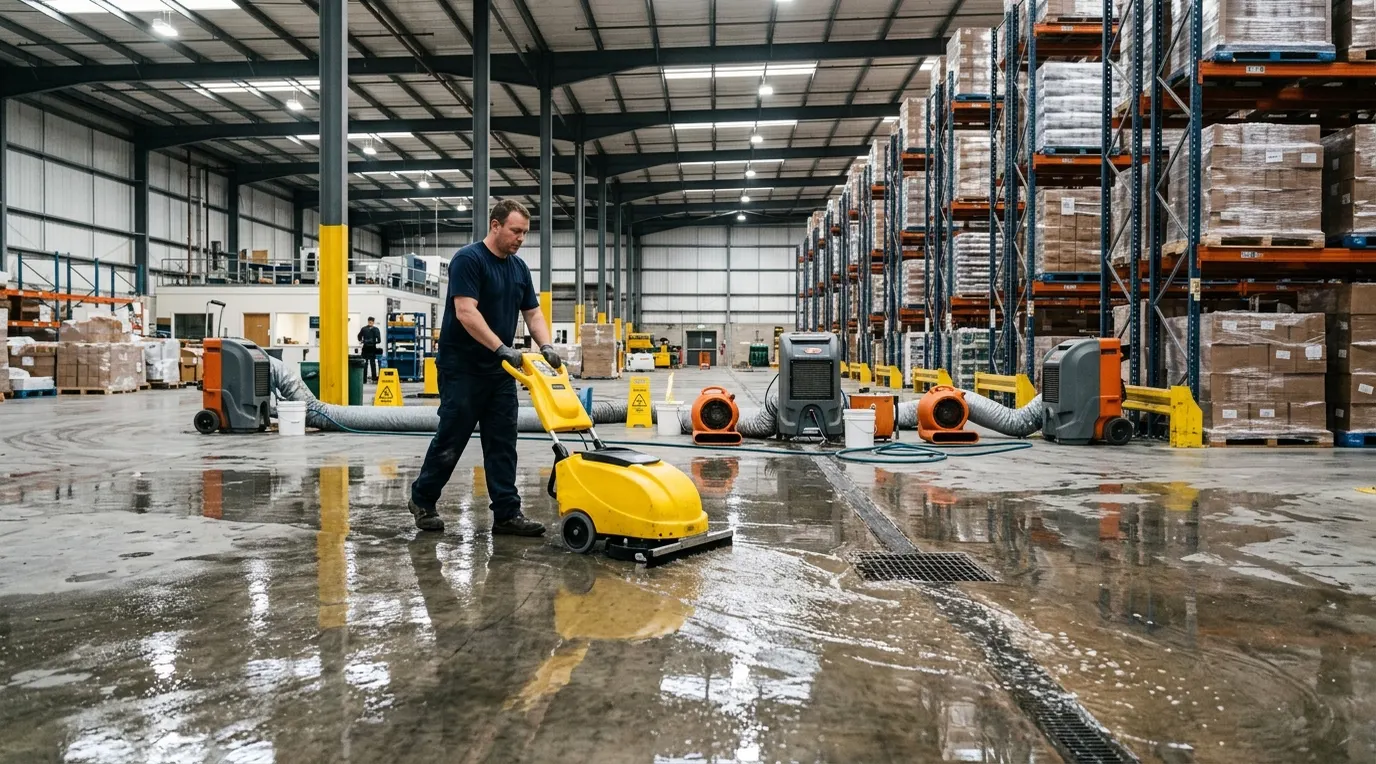
The first priority on any industrial loss is a thorough scope assessment before any equipment is staged. In a warehouse or manufacturing facility, that means walking the full affected area with moisture meters and thermal imaging to identify where water has migrated behind wall panels, under concrete slabs, or into mezzanine decking. Water follows the path of least resistance, and in a large open-span building, it can travel a significant distance from the source before pooling.
Once the scope is documented, extraction and drying equipment is sized to the actual cubic footage and material types involved, not to a generic formula. Large-capacity desiccant dehumidifiers are often the right tool in Rochester Hills facilities during winter months, because refrigerant-based units lose efficiency when ambient temperatures drop, and many industrial buildings are not fully climate-controlled throughout. Drying logs are maintained throughout the process to document conditions for both the facility owner and the insurance carrier.
Content and equipment protection runs parallel to structural drying. Production machinery, inventory, and tooling that cannot be relocated get protected in place. Where relocation is necessary, we coordinate with facility management on sequencing so that operations can continue in unaffected areas wherever possible.
Final clearance documentation is provided before the job is closed, giving the facility a written record of pre- and post-restoration moisture readings. That record matters for insurance purposes and for any future due-diligence review of the building.
Reaching Rochester Hills from Macomb
Flood Solutions Inc is based in Macomb, and Rochester Hills is a straightforward run west on M-59 or north on Van Dyke Avenue depending on the specific location within the city. The route is familiar territory, and the team dispatches with the equipment load appropriate to the reported loss type rather than sending a first unit light and restocking later.
For facilities in the northern portions of the city near the Auburn Hills border, access via M-59 to Adams Road is typically the most direct approach. Coordination on gate codes, dock access, and after-hours security contacts is handled before arrival so the crew is not waiting at a locked entrance when every hour of open drying time matters.
Rochester Hills Insurance and Carrier Coordination
Industrial losses in Rochester Hills typically involve commercial property carriers rather than standard homeowner policies, and the documentation requirements are more detailed. Flood Solutions Inc provides line-item loss documentation, moisture mapping reports, and equipment logs formatted to support the adjuster’s review process. Direct billing to commercial carriers is available, which keeps the facility owner out of the position of fronting restoration costs while waiting for reimbursement.
Business interruption coverage questions often come up on larger losses. While the coverage determination belongs to the carrier and the policyholder, thorough documentation of the timeline, affected square footage, and equipment downtime supports whatever claim the facility owner needs to make.
Local Note
One pattern that comes up specifically in Rochester Hills industrial buildings from the 1970s and 1980s construction era: metal wall panel systems in those facilities were often installed with fiberglass batt insulation pressed directly against the interior face of the panel with no true vapor barrier separation. When those panels take on moisture from a roof leak or a suppression discharge, the insulation holds water against the metal for an extended period, accelerating corrosion on the panel fasteners and framing. Standard moisture readings at the panel surface can read lower than the actual moisture content behind the batt. Thermal imaging is the reliable way to find those pockets, and it changes the drying plan significantly when they are present.
If your Rochester Hills facility has experienced a water loss, fire, or smoke event, call Flood Solutions Inc at (586) 580-0197 to schedule an assessment and get a clear picture of what the restoration process will involve.
Serving Rochester Hills from our Macomb headquarters — ★ 4.4 · 35 Google reviews
“Such a great experience this team was so helpful. Got my basement cleaned up and made sure there was no damage to the walls or anything else. They handled everything so fast.” — Danielle, October 2025Read our reviews on Google →
Industrial Restoration in Rochester Hills: Service Coverage
Frequently Asked Questions
How fast can you arrive for industrial restoration in Rochester Hills?
How does Flood Solutions Inc reach industrial facilities in the northern Rochester Hills area near the Auburn Hills border?
Does Rochester Hills' freeze-thaw climate affect how long industrial drying takes compared to warmer-climate facilities?
What makes fire and smoke restoration different in Rochester Hills manufacturing facilities compared to a commercial office building?
How does Flood Solutions Inc document an industrial loss in Rochester Hills for a commercial insurance carrier?
Are Rochester Hills industrial buildings from the 1970s and 1980s more likely to have hidden moisture problems after a water loss?
Industrial Restoration response in Rochester Hills
Most Rochester Hills calls see a technician on-site within 60 minutes from our Macomb headquarters.