Industrial Restoration in Macomb
Industrial restoration in Macomb and surrounding areas. Insurance billing accepted. Call (586) 580-0197.
When a burst pipe floods a warehouse floor at 3 a.m., or a grease fire tears through a manufacturing plant’s production wing, the scale of the problem is nothing like a residential loss. Standing water in a 40,000-square-foot facility can wick into concrete slabs, corrode steel racking, compromise electrical conduit, and halt production lines within hours. Industrial restoration in Macomb requires equipment, sequencing, and coordination that residential crews simply are not built for.
What industrial restoration actually involves
Industrial water damage, fire damage, and structural losses play out differently than residential ones in almost every dimension. Concrete floors absorb moisture slowly but hold it for weeks. Steel structural members corrode from the inside of wall cavities before surface rust appears. Smoke from synthetic materials used in manufacturing and warehousing, such as plastics, rubber, and coatings, leaves a different residue profile than wood smoke and requires different chemical neutralization. Mold colonization in a facility with poor air circulation can spread across a large footprint before it is visible.
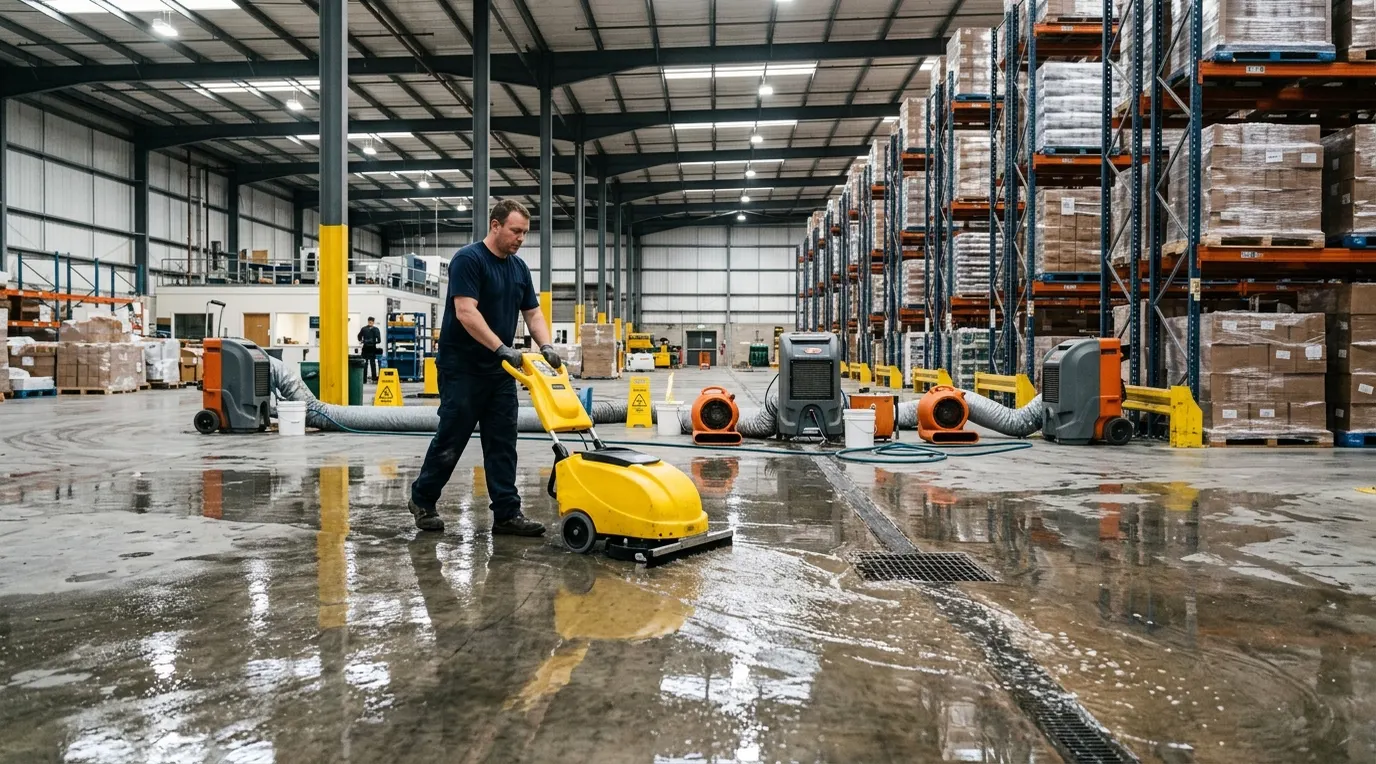
Industrial restoration work typically involves commercial-grade extraction units capable of moving hundreds of gallons per hour, desiccant dehumidification systems suited to large open spans, air movers positioned in calculated patterns across concrete and epoxy-coated floors, and thermal imaging to locate moisture behind insulated metal panels. For fire losses, industrial restoration includes soot characterization by material type, odor neutralization through thermal fogging or hydroxyl generation, and coordinated contents pack-out for salvageable equipment and inventory.
Timeline varies by loss type and facility size, but industrial structural drying typically runs longer than residential drying because of slab thickness, insulation density, and the sheer volume of affected cubic footage.
Our process
-
Site assessment and safety staging. Before any equipment moves in, the facility is evaluated for structural integrity, electrical hazards, and air quality. In a fire loss, this includes identifying areas where ceilings or mezzanine decking may be compromised. In a water loss, it includes locating the source and confirming it is controlled.
-
Containment and source isolation. For Category 2 or Category 3 water intrusions, affected zones are contained to prevent cross-contamination of clean inventory, equipment, or office areas. For fire losses, containment limits soot migration into unaffected production areas.
-
Extraction, debris removal, and initial drying setup. Industrial extraction equipment removes standing water from floor drains, low points, and pits. Debris, damaged insulation, and unsalvageable materials are removed to allow drying equipment to work against the actual structure rather than saturated contents. High-capacity dehumidifiers and air movers are positioned based on the facility’s layout and airflow characteristics.
-
Moisture monitoring and documentation. Concrete slabs, block walls, and steel-framed insulated panels are monitored at regular intervals using calibrated moisture meters and thermal imaging. Readings are logged and provided to the property owner and insurance carrier as part of the claim documentation package.
-
Restoration and return to operations. Once the structure meets drying targets, restoration work begins: repairing damaged wall panels, replacing insulation, restoring flooring surfaces, and coordinating with mechanical and electrical trades where needed. The goal is to return the facility to operational condition with as little disruption to the production schedule as possible.
What separates a good industrial restoration response from a bad one
The most common failure in industrial water damage response is treating a large facility like a scaled-up residential job. Residential desiccants and air movers are undersized for open warehouse spans. Residential moisture readings taken at drywall do not translate to concrete slab readings. A crew that does not understand how moisture moves through an insulated metal building panel will pull equipment too early and leave saturated insulation behind a dry-reading surface.
For industrial fire damage, the critical distinction is soot characterization. Synthetic materials common in manufacturing facilities produce wet, oily soot that bonds aggressively to metal surfaces and requires alkaline cleaning agents, not the dry-sponge methods used on protein soot. Skipping this step and applying the wrong chemistry can permanently etch or stain equipment and structural steel.
Insurance adjusters on commercial losses look for moisture logs with GPS-stamped readings, photo documentation of affected materials before removal, a written drying protocol, and a clear scope of work that separates emergency mitigation from restoration. Gaps in this documentation are the most common reason commercial claims are delayed or disputed.
What does industrial restoration cost?
Typical costs for industrial and warehouse restoration vary significantly based on the type of loss, the size of the affected area, and the materials involved. Most commercial water damage losses in the range of a few thousand square feet run between $15,000 and $80,000 for mitigation alone, with larger or more complex losses running higher. Industrial fire damage restoration, which includes soot remediation, odor neutralization, and structural repair, typically starts higher than water losses of equivalent size. Every loss is different, and Flood Solutions inc provides a written scope of work before any restoration begins so there are no surprises. Commercial property insurance typically covers sudden and accidental losses including water intrusion from burst pipes and fire damage, though policy terms, deductibles, and business interruption provisions vary.
| Scenario | Typical industry range |
|---|---|
| Small warehouse water loss, clean water, under 5,000 sq ft | $8,000 - $25,000 |
| Mid-size facility water loss, Category 2, 5,000-20,000 sq ft | $25,000 - $75,000 |
| Large plant water loss, Category 3, over 20,000 sq ft | $75,000 - $200,000+ |
| Industrial fire damage, partial production area | $40,000 - $150,000 |
| Full plant fire and smoke remediation | $150,000 - $500,000+ |
| Mold remediation, warehouse with HVAC spread | $20,000 - $60,000 |
Seasonal and regional considerations
Macomb County’s freeze-thaw cycle is one of the most consistent sources of industrial water losses in the region. Rooftop HVAC units, fire suppression lines in unheated storage bays, and overhead sprinkler systems in loading dock areas are all vulnerable when temperatures drop sharply in January and February. Facilities with older construction, common in Macomb’s industrial corridors, often have inadequate pipe insulation in exterior walls and roof penetrations. Spring snowmelt combined with clay-heavy soils in the area can also overwhelm floor drains and below-grade utility spaces in older manufacturing buildings.
Service area
Flood Solutions inc serves industrial and commercial facilities throughout Macomb and the surrounding communities, including Sterling Heights, Warren, Clinton Township, Shelby Township, Utica, and Romeo. The service-area pages for each city link back here for the full scope of what industrial restoration involves.
If your facility has experienced water intrusion, fire damage, or a loss that has stopped or threatened your operations, call Flood Solutions inc at (586) 580-0197 to schedule an on-site industrial assessment and get a written scope before work begins.
Frequently Asked Questions
Does commercial property insurance cover industrial water damage and warehouse restoration?
How is drying a warehouse or manufacturing facility different from drying a house?
What types of soot does manufacturing or warehouse fire damage produce, and why does it matter for cleanup?
How long does industrial structural drying typically take after a water loss?
Can production or warehouse operations continue during industrial restoration?
Looking for the best industrial restoration company in Macomb?
Flood Solutions inc provides industrial restoration in Macomb, MI and the surrounding area, and has served local property owners since 1996. Customers rate us 4.4 out of 5 stars across 35 Google reviews. We answer calls 24/7 — call (586) 580-0197 for immediate help.
Need Industrial Restoration now?
We respond 24/7 across Macomb and surrounding MI cities.
Related Coverage
- Our Restoration Services
- Contact Flood & Fire Solutions
- Industrial Restoration in Chesterfield
- Industrial Restoration in Clinton Township
- Industrial Restoration in Rochester Hills
- Industrial Restoration in Shelby Township
- Industrial Restoration in Sterling Heights
- Industrial Restoration in Troy
- Industrial Restoration in Utica
- Industrial Restoration in Warren