Industrial Restoration in Utica
Industrial restoration in Utica, MI. Insurance billing accepted. Call (586) 580-0197.
Our technicians are dispatched from our Macomb, MI headquarters and are typically on-site in Utica within 60 minutes of your call.
Utica sits at the heart of Macomb County’s industrial corridor, where decades of automotive supply chain activity have filled the area with manufacturing plants, warehouses, and fabrication facilities that were built fast and built to run hard. When a sprinkler line fails mid-shift, a roof drain backs up during a Great Lakes storm, or a fire tears through a paint booth, the damage compounds quickly in large-footprint buildings where square footage works against you. Flood Solutions Inc has been responding to industrial losses across southeast Michigan since 1996, and the conditions specific to this part of the state shape how that work gets done.
Why Utica Industrial Facilities Face Distinct Restoration Challenges
Macomb County’s industrial base grew rapidly through the mid-twentieth century, and many of the facilities operating in and around Utica today carry that legacy in their bones. Older tilt-up concrete construction, metal-deck roofing with aging membrane seals, and floor drains designed for a different era of production all create conditions where water intrusion spreads laterally before anyone notices it at the surface. The clay-heavy soils common across this part of Michigan drain poorly, which means groundwater pressure against slab edges and foundation walls increases significantly after prolonged rain or snowmelt events. Spring thaw in particular can push water into lower-level mechanical rooms and storage areas that stayed dry all winter.
Fire losses in manufacturing environments carry their own complexity. Smoke and soot from industrial materials, including plastics, synthetic lubricants, and coated metals, behave differently than residential fire residue. The particles are finer, travel farther through HVAC ductwork, and bond more aggressively to metal surfaces and equipment. Restoration timelines in these settings are driven as much by equipment decontamination and air quality as by structural drying.
The Industrial Restoration Process in Utica
Every commercial loss starts with a scope assessment before any equipment is staged. In an active or recently active manufacturing facility, that means identifying what’s running, what’s idle, and what inventory or tooling is at risk of secondary damage from moisture migration or residual smoke. Documentation happens in parallel, capturing affected areas with enough detail to support an insurance claim and give your carrier a clear picture of pre-loss conditions.
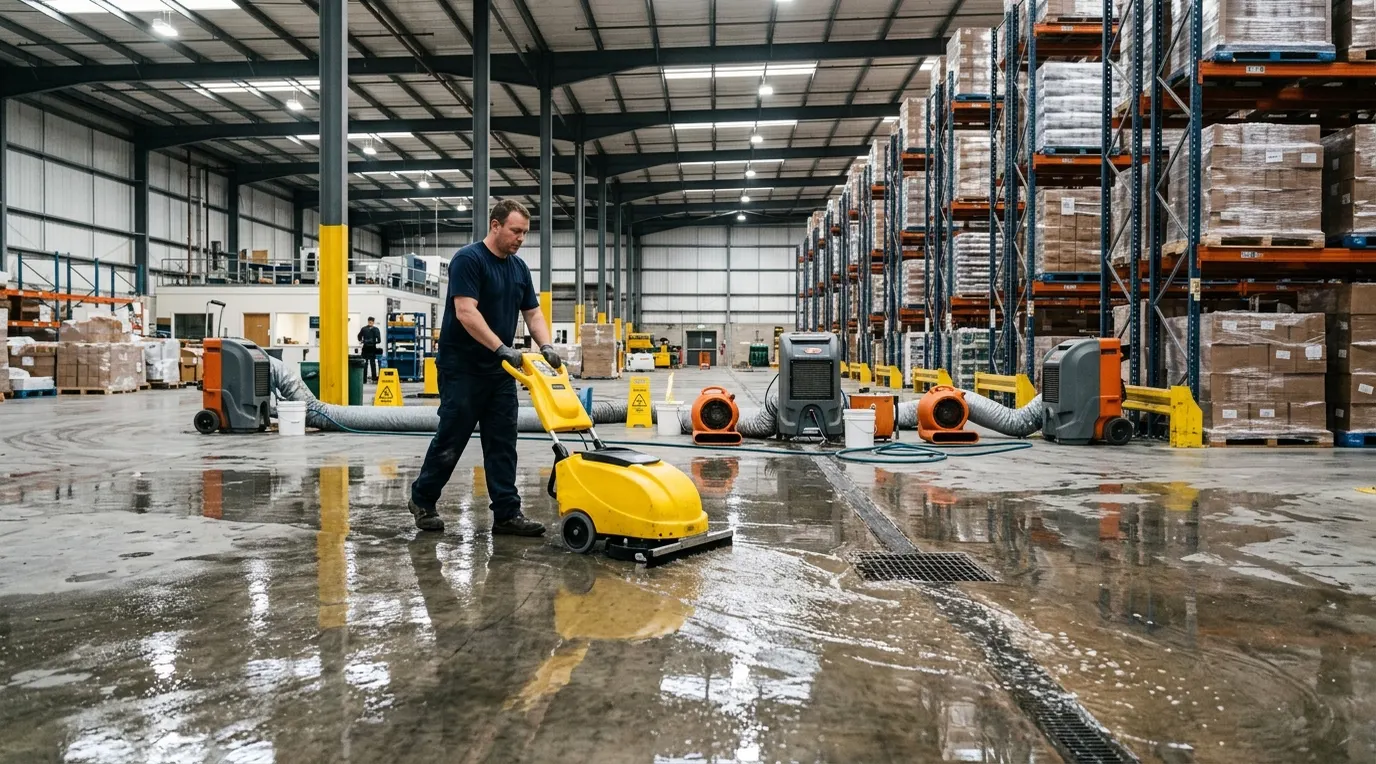
For water losses, industrial-scale drying requires high-capacity dehumidification and airflow equipment calibrated to the building’s volume, not residential units scaled up. Concrete slabs retain moisture for extended periods, and production can’t always wait for a full passive dry. Moisture mapping with thermal imaging and pin-probe readings guides the process so drying decisions are based on actual readings, not guesswork.
For fire and smoke losses, the sequence moves from emergency board-up and stabilization through content separation, structural cleaning, and duct decontamination. Odor neutralization in large industrial spaces requires thermal fogging or hydroxyl treatment at a scale matched to the building’s cubic footage.
Reaching Utica from Macomb
Flood Solutions Inc is headquartered in Macomb, which puts the Utica area well within the team’s primary service zone. M-59 and Van Dyke Avenue are the practical arteries connecting the two cities, and the route is straightforward under most conditions. For facilities located near the M-53 corridor or further east toward the Shelby Township line, the approach adjusts accordingly. Knowing the local road network matters when a crew is moving equipment trailers or large drying rigs, and it matters even more when a loss is still active.
Working with Insurance on Industrial Claims in Utica
Commercial property claims for industrial facilities involve more moving parts than residential losses. Business interruption coverage, equipment floaters, and separate policies for inventory or tooling can all be in play simultaneously. Flood Solutions Inc documents losses in a format that supports the adjuster’s workflow, including line-item scope reports, moisture logs, and photographic records organized by affected zone. Coordinating directly with the carrier’s commercial adjuster from the start reduces back-and-forth and keeps the claim moving while restoration work proceeds.
Local Note
Facilities in the Utica area that were built or expanded during the automotive boom years of the 1960s and 1970s often have roof drainage systems that were designed around production schedules rather than storm volume. Internal roof drains routed through interior columns can fail silently, releasing water into wall cavities or onto mezzanine-level equipment without triggering any floor-level alarm. If your facility has this type of drain configuration and you’ve had a water loss, it’s worth having the drain routing inspected as part of the restoration scope, not just the visible damage area.
Serving Utica from our Macomb headquarters — ★ 4.4 · 35 Google reviews
“Very knowledgeable and friendly employees. I had a flooded crawl space that I couldn't take care of myself. But Louis and his crew talked me through the whole process and then finished the job quickly and thoroughly.” — Chuck, October 2025Read our reviews on Google →
Industrial Restoration in Utica: Service Coverage
Frequently Asked Questions
How fast can you arrive for industrial restoration in Utica?
How does Macomb County's clay soil affect water damage in Utica industrial facilities?
Can Flood Solutions Inc handle an industrial fire loss at a large manufacturing facility in the Utica area?
How does Flood Solutions Inc document an industrial loss for a commercial insurance claim in Utica?
What's different about drying a concrete slab in a Utica warehouse compared to a standard commercial building?
How soon can Flood Solutions Inc begin work at a Utica facility after a loss is reported?
Industrial Restoration response in Utica
Most Utica calls see a technician on-site within 60 minutes from our Macomb headquarters.