Mold Remediation in Troy
Mold remediation in Troy, MI. Insurance billing accepted. Call (586) 580-0197.
Our technicians are dispatched from our Macomb, MI headquarters and are typically on-site in Troy within 60 minutes of your call.
Troy’s position in Oakland County puts it squarely in Michigan’s freeze-thaw belt, where late-winter temperature swings push moisture through foundation walls and into crawl spaces before most homeowners notice anything is wrong. By the time a musty smell reaches the living area or a dark stain appears along a basement wall, mold has often been colonizing behind drywall or under subflooring for weeks. Mold remediation in Troy is not a simple wipe-down job, it requires containment, source correction, and verified clearance to actually stop the cycle.
Why Troy Properties See Mold Issues
Oakland County’s clay-heavy soil holds water close to the surface long after a rain event or snowmelt. That sustained ground saturation presses against slab edges and block foundations, particularly in subdivisions built during Troy’s rapid residential expansion in the 1970s and 1980s. Homes from that era were often built with fiberglass batt insulation tucked against exterior walls, insulation that absorbs and holds moisture without showing visible damage until mold is already established inside the cavity.
Troy also sits in a zone where summer humidity regularly climbs above 70 percent for extended stretches. Attic spaces with inadequate ridge ventilation trap that humidity against roof sheathing, and mold can colonize OSB or plywood within 24 to 48 hours of a sustained moisture event. Finished basements, common in the ranch and colonial homes that make up much of Troy’s housing stock, add another layer of risk: carpeted concrete slabs and drywall that extends to the floor give mold an easy foothold after even a minor water intrusion.
The Mold Remediation Process in Troy
Effective mold abatement starts with a thorough moisture assessment, not just a visual inspection. Readings are taken at the wall cavity, subfloor, and ceiling plane using non-invasive meters, and any area reading above acceptable thresholds gets mapped before work begins. That map drives the containment plan.
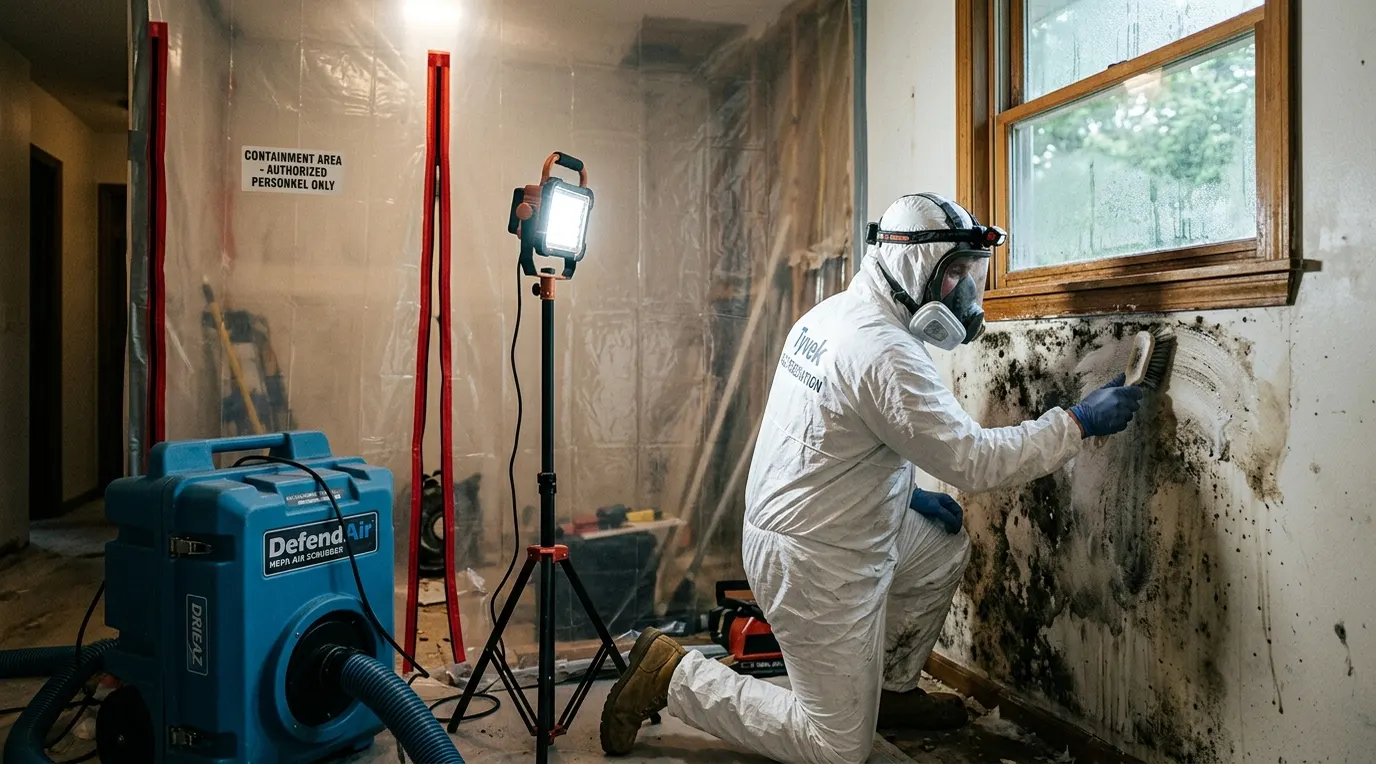
Physical containment uses 6-mil poly sheeting and negative air pressure to isolate the work zone from the rest of the home. HEPA-filtered air scrubbers run continuously during abatement, capturing airborne spores before they can resettle in unaffected rooms. Contaminated materials, drywall, insulation, carpeting, are bagged and removed per EPA guidelines. Structural surfaces that can be saved are treated with an antimicrobial agent, then dried to confirmed low-moisture readings before any rebuild begins.
In Troy homes with finished lower levels, the process often involves removing the bottom portion of drywall to inspect the full wall cavity rather than treating only the visible surface. Mold that is cleaned at the face but left behind the wall will return.
Reaching Troy from Macomb
Flood Solutions inc operates out of Macomb, which puts Troy within a straightforward drive via M-59 west to I-75 south, or along Hall Road into the city’s northern neighborhoods. For properties in Troy’s western corridors, the route along Big Beaver Road from the I-75 interchange provides direct access without navigating the interchange congestion near Somerset. Scheduling is handled by phone at (586) 580-0197, and the team coordinates arrival windows to fit your schedule.
Troy Insurance and HOA Coordination
Mold claims in Michigan are handled differently depending on the policy language, some carriers cover mold remediation only when it is directly tied to a covered water loss, while others require a separate mold rider. Flood Solutions inc documents the affected area with photographs, moisture readings, and written scope before any material is removed, which gives your adjuster a clear picture of the loss and the work required.
If your property falls within a Troy homeowners association, check your CC&Rs before work begins. Some HOAs in Troy’s planned communities require notification before exterior access panels or crawl space vents are opened, and a few require post-remediation air quality testing by an independent party before a clearance letter is issued. Knowing those requirements upfront prevents delays at the end of the job.
Local Note
Troy’s 1970s-era colonial and ranch homes were frequently built with a combination of wood-paneled basement walls and drop ceilings that conceal the floor joists above. When mold develops in that space, it is easy to underestimate the affected area because the visible surface looks limited. In practice, spores travel along the joist bays and can be found several feet beyond the visible stain. A thorough inspection in these homes always includes pulling a section of drop ceiling to check the joist cavities before finalizing the containment boundary.
If mold has appeared in your home or a property you manage in Troy, the right move is a proper assessment before any cleaning starts. Disturbing mold without containment spreads spores to unaffected areas and can make the remediation scope significantly larger. Call Flood Solutions inc at (586) 580-0197 to schedule an evaluation and get a clear picture of what you are dealing with.
Serving Troy from our Macomb headquarters — ★ 4.4 · 35 Google reviews
“Very knowledgeable and friendly employees. I had a flooded crawl space that I couldn't take care of myself. But Louis and his crew talked me through the whole process and then finished the job quickly and thoroughly.” — Chuck, October 2025Read our reviews on Google →
Mold Remediation in Troy: Service Coverage
Frequently Asked Questions
How fast can you arrive for mold remediation in Troy?
How does Troy's clay soil affect mold risk in basement and crawl space areas?
Are the ranch and colonial homes common in Troy more prone to hidden mold growth?
Does Troy have any HOA requirements that affect mold remediation work?
What does mold containment actually involve, and why does it matter in an occupied Troy home?
How does Flood Solutions inc document a mold loss for a Troy insurance claim?
Mold Remediation response in Troy
Most Troy calls see a technician on-site within 60 minutes from our Macomb headquarters.