Mold Remediation in Macomb
Mold remediation in Macomb and surrounding areas. Insurance billing accepted. Call (586) 580-0197.
You notice a musty smell first, maybe in the basement or behind a bathroom wall. Then you spot the discoloration: dark patches spreading across drywall, a fuzzy growth along a baseboard, or a greenish-black stain creeping out from under the vanity. Mold does not wait. Within 24 to 48 hours of a moisture event, spores already present in any home can begin to colonize porous materials. By day three or four, what started as a small wet spot can become a remediation project that requires containment, air filtration, and careful material removal to resolve safely.
What mold remediation actually involves
Mold remediation is not the same as wiping down a surface with bleach. Bleach kills surface mold on non-porous materials, but it does not penetrate drywall, wood framing, or insulation, and it does nothing to address the spore load suspended in the air around the colony. Professional mold abatement addresses the contamination at every level: the visible growth, the affected building materials, and the air quality in and around the work zone.
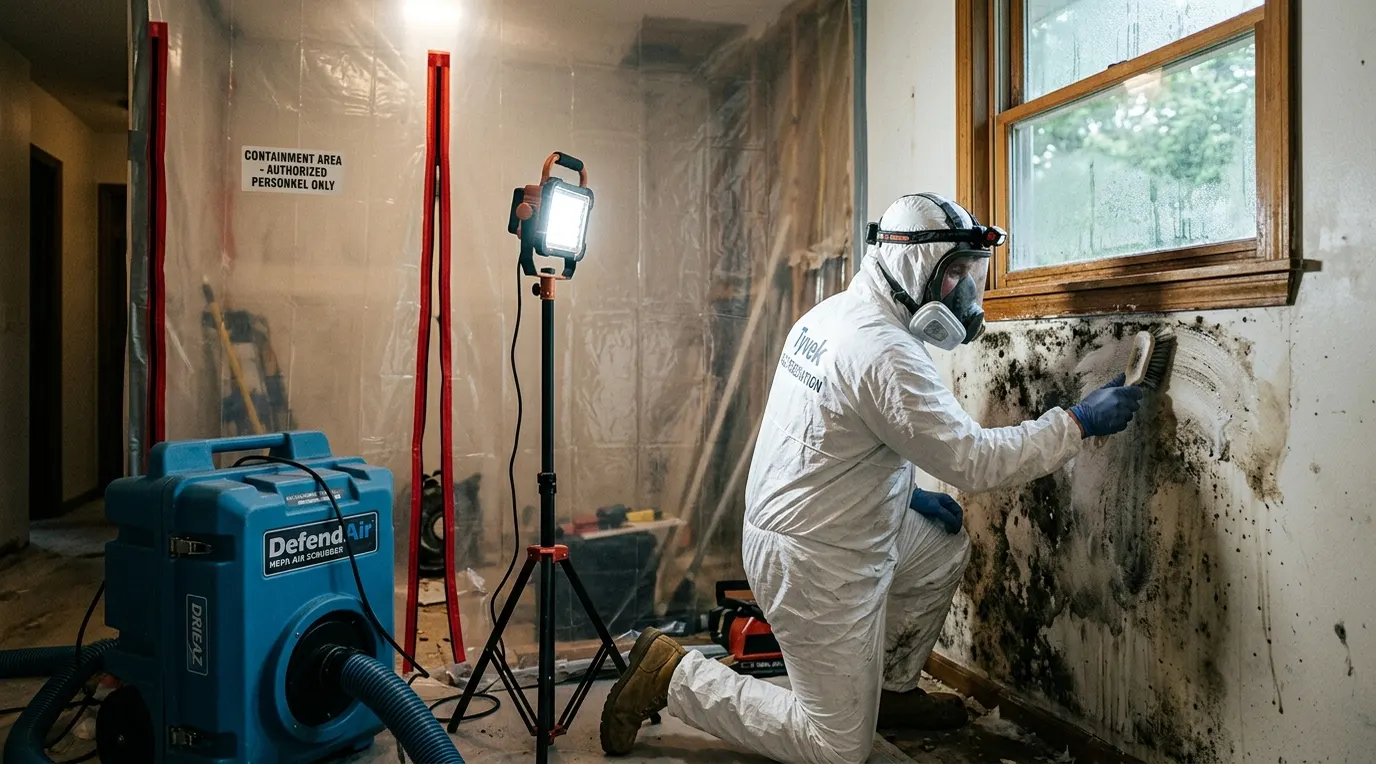
The equipment used in a proper mold cleanup job reflects that complexity. HEPA air scrubbers run continuously inside the containment zone, pulling spore-laden air through filters rated to capture particles as small as 0.3 microns. Negative air pressure machines exhaust filtered air to the exterior, preventing cross-contamination to unaffected rooms. Affected drywall, insulation, and wood that cannot be cleaned to a visually clean, dry standard are removed and bagged in sealed poly before being transported out of the containment area.
Timeline varies with the scope of the loss. A single-room mold containment and removal project may take one to three days. A crawl space with widespread colonization, or a finished basement where mold has spread behind multiple walls, can run a week or more, particularly if structural drying of the underlying moisture source is needed before remediation can be completed.
Our process
-
Initial assessment and moisture mapping. Before containment goes up, the source of moisture driving the mold growth is identified. Thermal imaging and moisture meters locate elevated readings behind walls and under flooring. Remediating mold without addressing the moisture source guarantees regrowth.
-
Containment and negative air pressure. Affected areas are isolated with poly sheeting and zipper doors. Negative air pressure machines exhaust filtered air outside the work zone, so spores disturbed during removal do not migrate to clean areas of the home. This step is non-negotiable on any project where mold growth exceeds a small, isolated patch.
-
HEPA vacuuming and material removal. Visible mold on hard surfaces is HEPA-vacuumed before any scrubbing or demolition begins. This reduces the airborne spore count before materials are disturbed. Porous materials that cannot be cleaned to a visually clean standard, including drywall, insulation, and heavily affected wood, are removed, double-bagged, and sealed inside the containment zone before transport.
-
Antimicrobial treatment and encapsulation. After removal, remaining structural surfaces are treated with EPA-registered antimicrobial agents. In some cases, an encapsulant is applied to wood framing to seal residual spores that cannot be physically removed by sanding alone.
-
Post-remediation air sampling and clearance. Clearance testing compares indoor spore counts and species to outdoor baseline samples. A successful clearance confirms that the remediation returned the indoor environment to a normal fungal ecology. Containment is not removed until clearance criteria are met.
What separates a good mold remediation response from a bad one
The most common failure in mold cleanup is skipping or shortcutting containment. Disturbing an active mold colony without negative air pressure and poly barriers disperses spores throughout the HVAC system and adjacent rooms, turning a localized problem into a whole-house one. Adjusters and industrial hygienists reviewing a claim can often tell from air sampling results whether containment was properly maintained during the work.
A second frequent mistake is treating the visible mold without identifying the moisture source. If a slow roof leak, a failed pipe penetration, or chronic condensation behind an exterior wall is not corrected before remediation, regrowth typically appears within weeks. Good operators document the moisture source, confirm it has been corrected or isolated, and note that in the project file.
Insurance adjusters reviewing mold claims look for a written scope of work that distinguishes between affected materials that were cleaned in place and those that were removed, along with pre- and post-remediation air sampling results from a qualified industrial hygienist. Projects that lack clearance documentation are harder to close and harder to defend if a buyer’s inspector raises questions later.
What does mold remediation cost?
Typical costs for mold remediation depend heavily on the size of the affected area, the materials involved, and whether structural drying or reconstruction is needed afterward. Most homeowners pay somewhere in the following ranges for common scenarios:
| Scenario | Typical range |
|---|---|
| Single bathroom, surface mold on tile and drywall | $500 - $1,500 |
| Single room, drywall removal and containment | $1,500 - $4,000 |
| Basement mold remediation, partial wall removal | $3,000 - $8,000 |
| Crawl space remediation with encapsulation | $4,000 - $12,000 |
| Whole-house or multi-room mold abatement | $10,000 - $30,000+ |
These are typical industry figures. Every mold loss is different, and Flood Solutions inc provides a written scope before any work begins so you know exactly what is included. Homeowners insurance may cover mold remediation when the mold results from a covered sudden and accidental water loss, such as a burst pipe, but policies vary and many exclude mold that developed from long-term seepage or maintenance issues.
Seasonal and regional considerations
Macomb County’s climate creates specific mold risk windows. Hot, humid summers push indoor humidity into ranges where mold can colonize even without a visible leak, particularly in basements and crawl spaces with inadequate vapor barriers. The freeze-thaw cycles common to southeast Michigan drive ice damming on older rooflines, and the slow melt that follows often goes undetected inside attic sheathing and top-floor wall cavities until spring brings warmer temperatures and visible growth. Homes built before the 1980s in Macomb and the surrounding communities frequently have older plumbing and less vapor-resistant building assemblies, making them more susceptible to the slow moisture intrusion that feeds mold over months rather than days.
Where mold starts in Macomb County homes
Most of the mold we are called to in this area begins below grade. Southeast Michigan sits on slow-draining lake-plain clay, so after a heavy rain the soil holds water against foundation walls instead of letting it soak away, and a basement that stays dry most of the year can take on water through floor cracks, wall seams and window wells. The Clinton River runs through Rochester Hills, Shelby Township, Utica, Sterling Heights and Clinton Township on its way to Lake St. Clair, and the low ground along it and along the lakeshore toward Chesterfield is where groundwater and backup problems show up first.
Large storms are the other driver. The August 2014 storm that dropped record rainfall on metro Detroit flooded basements by the thousands across Warren, Sterling Heights and neighboring cities, and mold followed in many of the homes where carpet, drywall and stored belongings stayed wet for days. That pattern repeats after every major storm: a flooded basement that is pumped out but not properly dried becomes a mold job within weeks. If your basement has taken on water, water damage restoration and basement flooding cleanup done promptly is the cheapest mold prevention there is. If you are not sure whether you have mold at all, start with mold inspection and testing before anyone opens a wall.
Service area
Flood Solutions inc handles mold remediation in Macomb and across the surrounding communities, with a page for each city: Sterling Heights, Clinton Township, Shelby Township, Chesterfield, Warren, Utica, Troy and Rochester Hills. Each city page links back here for the full technical detail on the remediation process.
If you are seeing signs of mold growth or have recently had a water loss, call (586) 580-0197 to request an air quality assessment and get a written scope before any work begins.
Services We Handle
- Attic Mold Removal
- Basement Mold Removal
- Bathroom Mold Removal
- Black Mold Removal
- Crawl Space Mold Removal
- Emergency Mold Removal
- Kill Mold
- Mold Removal Behind Walls
Frequently Asked Questions
Does homeowners insurance cover mold remediation?
What level of mold growth actually requires professional containment?
What is clearance testing and do I actually need it?
Can mold come back after professional remediation?
What should I do, and not do, while waiting for a mold remediation crew?
Why does mold show up in so many Macomb County basements?
Do I need mold testing before remediation?
Looking for the best mold remediation company in Macomb?
Flood Solutions inc provides mold remediation in Macomb, MI and the surrounding area, and has served local property owners since 1996. Customers rate us 4.4 out of 5 stars across 35 Google reviews. We answer calls 24/7 — call (586) 580-0197 for immediate help.
Need Mold Remediation now?
We respond 24/7 across Macomb and surrounding MI cities.
Related Coverage
- Our Restoration Services
- Contact Flood & Fire Solutions
- Emergency Water Damage Restoration in Macomb
- Emergency Sewage Cleanup and Sanitization in Macomb
- Emergency Storm Damage Restoration in Macomb
- Emergency Smoke Damage Restoration in Macomb
- Emergency Flood Damage Restoration in Macomb
- Mold Remediation in Chesterfield
- Mold Remediation in Clinton Township
- Mold Remediation in Rochester Hills
- Mold Remediation in Shelby Township
- Mold Remediation in Sterling Heights
- Mold Remediation in Troy
- Mold Remediation in Utica
- Mold Remediation in Warren
- How To Choose a Restoration Company in Macomb (Without Getting Burned)
- How To Test for Mold in Your Home (DIY Kits vs a Pro Inspection)
- 7 Signs You Have Hidden Mold (and What To Do Next)