
Mold does not always announce itself with a black stain on the ceiling. More often it grows in the dark, behind drywall, under flooring, inside HVAC ducts, and inside wall cavities where a slow drip has been feeding it for weeks. By the time you see it, the colony is already established. These seven signs can help you catch it earlier, before the remediation scope grows with it.
1. A Persistent Musty Smell That Moves Around
Mold produces microbial volatile organic compounds (mVOCs) as it metabolizes organic material. That earthy, damp-basement smell is those compounds off-gassing into your living space. If the odor is stronger in one room, near a specific wall, or when your HVAC kicks on, that tells you something. A smell that intensifies after rain or after running the bathroom exhaust fan is particularly telling, moisture is entering somewhere, and something is feeding on it.
Do not assume the smell is just an old house. Macomb County has a significant share of homes built in the 1960s through 1980s with plaster-over-lath walls and original copper or galvanized plumbing. Those wall assemblies trap moisture differently than modern drywall, and a slow pinhole in aging pipe can saturate lath for months before you notice anything on the surface.
2. Warped, Buckled, or Soft Flooring
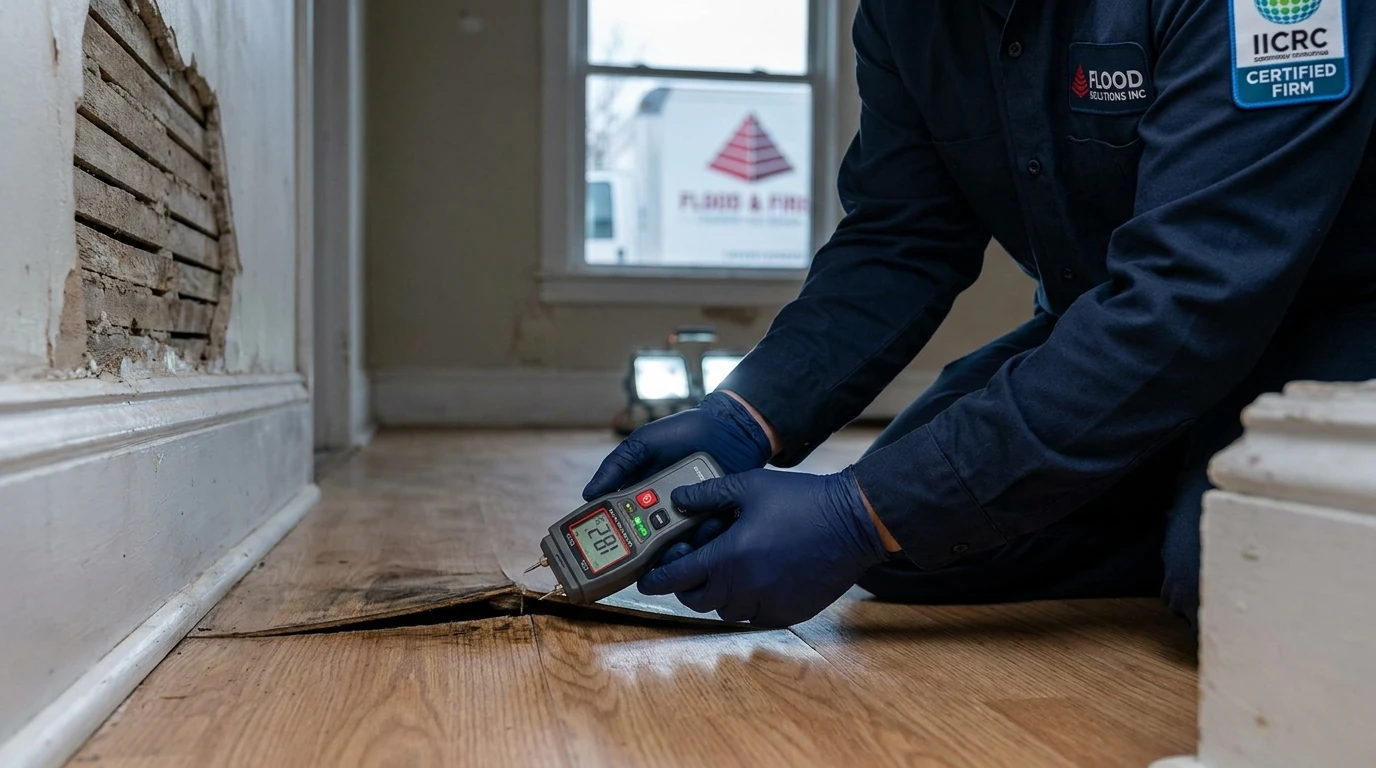
Wood and laminate flooring buckle when the subfloor beneath them stays wet. If you press down on a section of floor and feel a slight give, or notice boards cupping at the edges, check for a moisture source directly below. In bathrooms, the wax ring at the toilet base is a common culprit. In kitchens, look at the base of the dishwasher and the area under the sink.
Mold can colonize OSB subfloor within 24 to 48 hours of sustained saturation. The flooring on top may look fine and even feel dry at the surface while the subfloor underneath is actively growing mold. A moisture meter pushed through a small test hole in the baseboard can tell you what your eyes cannot.
3. Peeling Paint or Wallpaper That Is Not Near a Window
Paint peels near windows because of condensation. When it peels on an interior wall, or on a ceiling away from any obvious water source, that is a different conversation. Moisture vapor migrating through a wall from a wet cavity will break the bond between paint and substrate. If you peel back a corner and the drywall paper underneath is dark or stained, stop there and call someone who can test it.
4. Unexplained Allergy or Respiratory Symptoms at Home
Mold spores are small enough to stay airborne for hours. If anyone in the household has developed a cough, nasal congestion, or eye irritation that clears up when they leave the house and returns when they come back, the indoor air quality deserves attention. This is especially relevant for anyone with asthma or an existing respiratory condition.
This post cannot and does not offer medical advice. If symptoms are serious, consult a physician. What it can say is that persistent, location-specific symptoms are worth investigating on the building side as well.
5. Visible Staining That Is Not Where You Expect It
Not all mold is black. It can appear as gray, green, white, or even orange patches depending on the species and what it is growing on. A common mistake is assuming a white powdery stain on concrete is mold when it is actually efflorescence (mineral deposits from water moving through masonry). Efflorescence is not mold, but it does confirm that water is moving through that wall, which means conditions for mold exist nearby.
If you see staining on drywall, ceiling tile, or wood framing, do not paint over it. Paint will cover the stain but will not stop the colony. Within weeks, the stain will bleed back through.
6. A Past Leak That Was Dried Quickly and Forgotten
This one is less a visible sign and more a history question. Think back: has there been a roof leak, a supply line failure, a slow drip under a sink, or any flooding in the last one to three years? If that event was addressed by mopping up standing water and running a box fan, the materials behind and beneath the wet area may never have dried to an acceptable moisture content.
The IICRC S520 standard for mold remediation and the S500 standard for water damage both define acceptable moisture levels for structural materials. A box fan does not achieve those levels in wall cavities or under flooring. If the drying was not done with professional equipment and verified with moisture readings, assume the job may not be finished.
7. Rust or Corrosion on Pipes, Fasteners, or HVAC Components
Metal corrodes when it stays wet. If you open a cabinet under a sink and see rust staining on the cabinet floor, or if you look at your HVAC air handler and see rust on the housing or on the screws holding the access panel, that is evidence of sustained moisture exposure. Mold inside an HVAC system is a particular concern because the blower distributes spores throughout every room the system serves.
If you see corrosion inside the air handler or on the evaporator coil housing, have the system inspected before running it further.
What To Do If You Recognize These Signs
Start by finding and stopping the moisture source. Mold remediation without addressing the underlying moisture problem is a temporary fix. If the source is a plumbing leak, get it repaired first. If it is condensation from a crawl space or basement, that is a separate project.
Once the source is controlled:
- Do not disturb suspected mold by scrubbing, sanding, or blowing air across it. Disturbing a colony releases spores into the air.
- Limit access to the affected area, especially for children, elderly residents, or anyone with respiratory conditions.
- Document what you see with photos before anything is moved or cleaned.
- If the affected area is larger than about 10 square feet, the EPA recommends professional remediation rather than DIY cleanup.
For smaller surface mold on non-porous materials (tile grout, glass, metal), cleaning with an appropriate solution and controlling the moisture source may be sufficient. For anything on drywall, wood framing, insulation, or subfloor, those materials typically need to be removed rather than cleaned.
When To Call a Professional
Call a mold remediation professional when: the affected area is larger than a single surface patch, the mold is inside a wall cavity or under flooring, someone in the home is experiencing symptoms, or you have had a significant water loss in the past and are not certain the drying was completed properly.
A professional assessment will include moisture mapping of the surrounding area, not just the visible stain. That matters because mold often extends further than the visible growth, and remediation that does not address the full affected area will leave the problem partially in place.
If you are in Macomb or the surrounding area and you are seeing these signs, Flood Solutions Inc. can assess the situation and walk you through what remediation would involve. Reach the team at (586) 580-0197.