
The Short Answer: Color Alone Won’t Tell You
If you spotted a dark stain on your ceiling or a fuzzy growth behind the washing machine, your first instinct was probably to wonder whether it’s the dangerous kind. Here’s the honest answer: you cannot reliably identify mold species by color with the naked eye. “Black mold” is a nickname for Stachybotrys chartarum, but dozens of other species also appear black, gray, or dark green. Meanwhile, Stachybotrys itself can look greenish or slimy depending on moisture levels. Color is a starting point, not a diagnosis. What actually matters is where it’s growing, how much of it there is, and what conditions let it get there in the first place.
What People Mean When They Say “Black Mold”
Stachybotrys chartarum earned its reputation because it produces mycotoxins, compounds that can cause respiratory irritation, headaches, and other symptoms in sensitive individuals. It thrives on cellulose-rich materials that have stayed wet for an extended period, typically more than 72 hours. Drywall paper, ceiling tiles, and wood framing are its preferred surfaces.
The catch is that Stachybotrys is actually one of the less common molds found in homes. The mold you’re more likely to encounter falls into a handful of other genera:
- Cladosporium: Olive-green to black, powdery texture, common on window sills, grout, and HVAC vents. One of the most widespread indoor molds.
- Aspergillus: Ranges from white to yellow, green, or black depending on the species. Often found on damp insulation and around air handlers.
- Penicillium: Blue-green, velvety, spreads quickly on water-damaged building materials and stored items.
- Alternaria: Dark green or brown, often found in showers, under sinks, and around leaky windows.
None of these are harmless, but none of them are Stachybotrys either. The only way to confirm which species you have is laboratory analysis of a physical sample, a process called mold testing or air quality sampling.
How to Tell What You’re Looking At (Without a Lab)
While you can’t identify species visually, you can gather useful clues about the severity of the situation.
Texture and growth pattern
Stachybotrys tends to appear slimy or wet-looking when actively growing, and it produces a distinctly musty, earthy odor that gets stronger in humid conditions. Most other common molds look powdery, fuzzy, or chalky. If the growth looks like it’s glistening and sits on a surface that has been wet for weeks, not just days, that’s a reason to take it more seriously.
Surface and location
Mold growing on grout or a tile wall is almost certainly not Stachybotrys, which needs cellulose to colonize. Mold growing on drywall paper, wood studs, or ceiling tile after a slow leak or flooding event is a different situation entirely.
Size of the affected area
The EPA’s general guidance distinguishes between small areas (roughly 10 square feet or less) and larger infestations. A patch the size of a dinner plate on a bathroom wall is a different problem than growth spreading across multiple wall cavities after a plumbing failure. Larger areas almost always indicate that moisture has penetrated behind surfaces, meaning what you can see is not the whole picture.
What you smell but can’t see
A persistent musty odor without visible growth is often more concerning than visible surface mold. It usually means colonization is happening inside a wall, under flooring, or in a crawl space where you can’t easily inspect.
What NOT to Do When You Find Mold
A few common reactions can make the situation significantly worse.
-
Don’t spray bleach on it and call it done. Bleach kills surface mold on non-porous materials like tile, but it doesn’t penetrate porous surfaces like drywall or wood. The visible stain may fade, but the root structures (hyphae) remain, and regrowth is likely. More importantly, bleach does nothing to address the moisture source that allowed mold to grow in the first place.
-
Don’t sand or scrub dry mold without respiratory protection. Disturbing mold releases spores into the air. If you’re going to clean a small surface area, wear an N95 respirator at minimum, not a paper dust mask.
-
Don’t seal over it. Painting or caulking over mold traps moisture and organic material. The colony continues to grow underneath.
-
Don’t run fans to dry out a moldy area without containment. Fans spread spores to unaffected parts of the house. If you have visible mold growth, drying equipment should be used as part of a controlled remediation process, not as a DIY first step.
-
Don’t ignore a small patch if you’ve had a recent water event. Surface mold that appears within days of a leak or flood is a sign that conditions are right for much larger growth. The 72-hour window for mold colonization after water intrusion is real, and what’s visible on day five is rarely the full extent of the problem.
When to Call a Mold Remediation Professional
Some mold situations are genuinely manageable without professional help. A small patch on a bathroom tile, a bit of mildew on a window frame, or surface growth on a single non-porous area can often be addressed with proper cleaning and improved ventilation.
Call a professional when:
- The affected area is larger than roughly 10 square feet.
- Mold is growing on drywall, wood framing, insulation, or ceiling tiles.
- You have a musty odor but can’t locate the source.
- The growth appeared after a flood, burst pipe, roof leak, or sewage backup.
- Anyone in the household has respiratory conditions, allergies, or a compromised immune system.
- You’ve cleaned the same area more than once and it keeps coming back.
- You suspect mold is inside walls or under flooring.
A certified mold remediation contractor will assess the moisture conditions driving the growth, not just the visible colony. Remediation without fixing the moisture source is a temporary fix at best.
If you’re in Macomb County and you’re not sure what you’re looking at, Flood Solutions inc can assess the situation. Reach them at (586) 580-0197.
What Professional Mold Remediation Actually Involves
Understanding the process helps you evaluate whether a contractor is doing the job correctly.
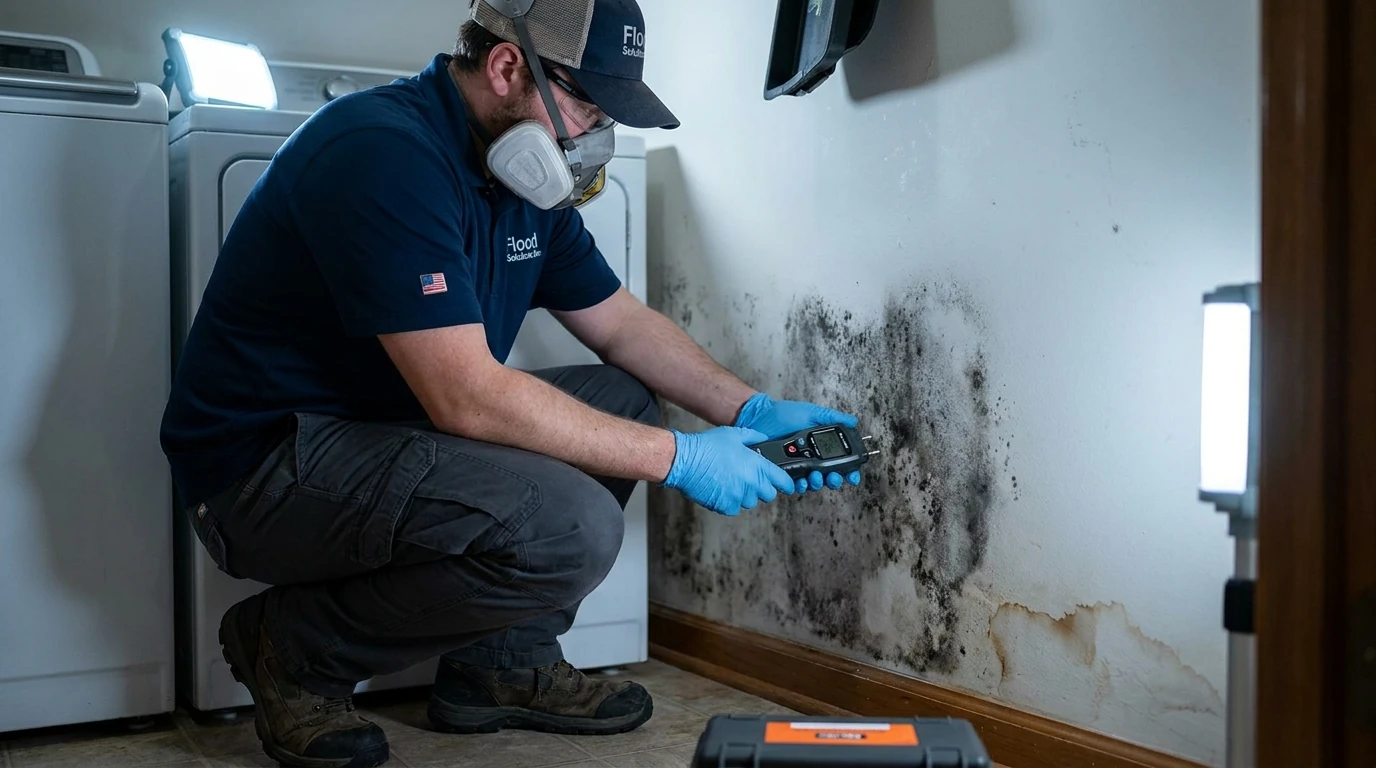
A proper remediation starts with moisture mapping, using meters and sometimes thermal imaging to locate wet building materials that aren’t visible to the eye. Affected areas are contained with plastic sheeting and negative air pressure to prevent spores from spreading to clean parts of the structure. Porous materials that are colonized, drywall, insulation, wood with deep penetration, are removed rather than cleaned in place. The remaining structure is HEPA-vacuumed and treated with an antimicrobial agent. Drying equipment runs until moisture readings return to normal baselines for the materials involved.
After remediation, a post-remediation verification (sometimes called clearance testing) confirms that spore counts have returned to acceptable levels before reconstruction begins. If a contractor skips this step, you have no objective confirmation the problem is resolved.
The Bottom Line
Black mold is a real concern, but the fear around it has made it easy to either panic over ordinary surface mold or, conversely, dismiss a serious infestation because it doesn’t look the way you expected. The color of the growth tells you less than the surface it’s on, the moisture conditions that created it, and how far it’s spread. When in doubt, especially after any water damage event, a professional assessment gives you actual information rather than a guess. If you’re dealing with mold in the Macomb area, Flood Solutions inc offers mold remediation services and can help you understand what you’re working with before the problem grows.