Emergency Flood Damage Restoration in Macomb
Emergency flood damage restoration in Macomb and surrounding areas. Insurance billing accepted. Call (586) 580-0197.
Flooding emergency in Macomb? Call now for emergency service. Our crew responds fast to pump out the water and stop the damage from spreading.
Standing water is only the beginning. Once a flood recedes, the real damage is already spreading: saturated subfloors wicking moisture upward into wall cavities, drywall acting as a sponge behind intact paint, and the 24-to-48-hour window before microbial growth takes hold ticking down fast. Flood damage restoration is not the same as mopping up and running fans. It requires systematic extraction, calibrated drying, and documentation that holds up when your insurance adjuster reviews the claim.
What flood damage restoration actually involves
Floodwater is almost never clean. Whether the source is a backed-up storm drain, an overflowing sump pit, or surface water entering through a basement wall, the water carries sediment, bacteria, and contaminants that classify it as Category 2 or Category 3 under industry standards. That classification changes everything: which materials can be dried in place versus removed, what personal protective equipment crews use, and how waste is handled.
The visible waterline on your drywall is not the boundary of the damage. Moisture migrates. Hardwood floors cup and buckle as moisture moves through the tongue-and-groove joints. Insulation in crawlspaces and rim joists retains water long after the surface feels dry. Concrete block foundations absorb and slowly release moisture into adjacent framing. Thermal imaging and calibrated moisture meters reveal what eyes and hands cannot.
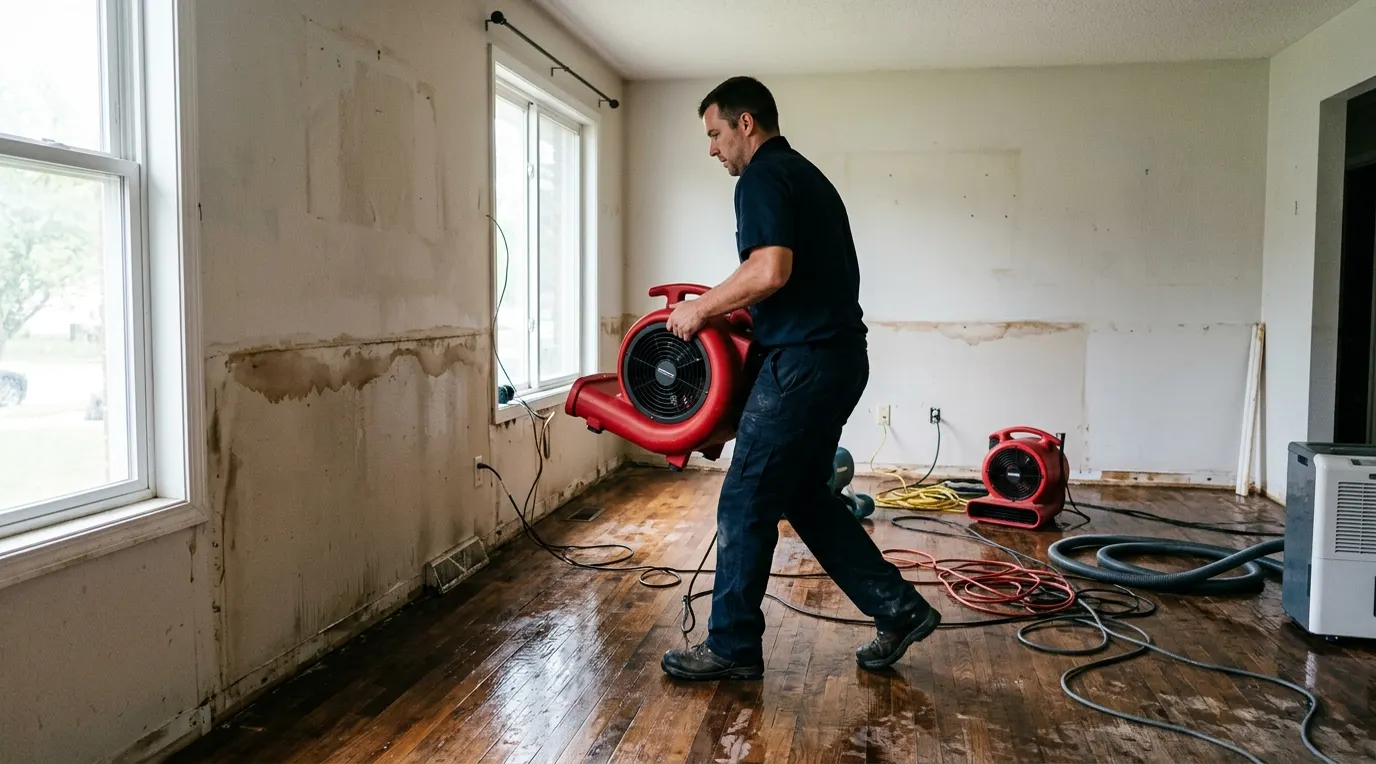
Equipment matters here. Truck-mounted or high-capacity portable extractors remove bulk water far faster than wet-vacs. Desiccant or refrigerant dehumidifiers, sized to the affected cubic footage, pull moisture from the air and from building materials simultaneously. Air movers are positioned at calculated angles to create turbulent airflow across wet surfaces, not just to move air around a room.
Our process
-
Initial assessment and water classification. Before extraction begins, the source and contamination level of the water are identified. Category 3 (grossly contaminated) water requires different containment and disposal protocols than Category 2. Moisture readings are taken at the perimeter and in adjacent rooms to map the full extent of migration.
-
Bulk water extraction. High-capacity extractors remove standing water from floors, carpet, and subfloor assemblies. Trapped water under floating floors or in wall cavities may require controlled access points to reach effectively.
-
Contaminated material removal. Drywall, insulation, and flooring that have absorbed Category 2 or 3 water cannot be dried in place safely. Affected materials are removed to the flood cut line, bagged, and disposed of properly. This step also opens wall cavities for drying and inspection.
-
Structural drying with daily monitoring. Industrial dehumidifiers and air movers run continuously. Moisture readings are logged daily at each monitoring point. Drying is not complete when the surface feels dry; it is complete when readings return to pre-loss equilibrium values for the material type and local ambient conditions. In Macomb’s humid summers, that baseline matters.
-
Post-drying documentation and scope for reconstruction. Once drying goals are met, a final moisture report is generated. That report, combined with the photo documentation from each stage, forms the basis for the reconstruction scope and the insurance claim package.
What separates a good flood damage response from a bad one
The most common mistake in residential flood cleanup is stopping at what is visible. A crew that extracts standing water, runs fans for two days, and declares the job done leaves saturated framing and subfloor behind. Mold colonization in those cavities typically becomes apparent within two to three weeks, and by then the remediation cost has multiplied.
A second frequent failure is misclassifying the water source. Treating Category 3 floodwater the same as a clean supply line break skips the antimicrobial treatment and contaminated-material disposal steps that protect occupant health and satisfy insurance documentation requirements.
Insurance adjusters reviewing a flood claim look for a moisture log with dated readings at labeled monitoring points, photographic documentation of the flood cut and removed materials, and a drying report that shows readings trending to goal. Claims without that documentation are harder to process and more likely to result in disputes over scope.
Skipping containment when neighboring rooms are unaffected is another gap. Cross-contamination from Category 3 water can compromise areas that were dry at the start of the job.
What does flood damage restoration cost?
Typical costs for residential flood damage restoration vary based on the size of the affected area, the water category, and how much structural material requires removal. Most homeowners pay somewhere in the ranges below, based on industry benchmarks. Every loss is different, and Flood Solutions inc provides a written scope of work before any work begins so you know exactly what is included. Homeowners insurance policies that include sudden and accidental water damage coverage typically cover flood cleanup costs when the source is internal (sump failure, drain backup with a rider) but standard policies generally exclude rising groundwater; a separate flood insurance policy through the National Flood Insurance Program (NFIP) covers that.
| Scenario | Typical industry range |
|---|---|
| Single room, Category 1 water | $1,200 - $3,500 |
| Single room, Category 2 or 3 water | $2,500 - $6,000 |
| Basement, partial flooding, Category 2 | $4,000 - $10,000 |
| Finished basement, full flooding, Category 3 | $8,000 - $20,000+ |
| Multi-room main floor flood event | $7,000 - $18,000 |
| Crawlspace flooding with insulation removal | $3,000 - $8,500 |
Seasonal and regional considerations
Macomb County sits in a region where spring snowmelt and heavy April and May rains regularly overwhelm aging storm infrastructure. Sump pumps that run hard all spring are the ones most likely to fail during a summer thunderstorm when the water table is already elevated. Homes built in the postwar decades common throughout Macomb often have block foundation walls that are more porous than poured concrete, making basement seepage a recurring issue rather than a one-time event. Late-summer humidity in southeast Michigan also extends structural drying timelines compared to drier climates, which is why daily moisture monitoring matters more here than in many other markets.
Service area
Flood Solutions inc is based in Macomb and provides flood cleanup and post-flood restoration throughout Macomb County, including Sterling Heights, Clinton Township, Shelby Township, Chesterfield, Warren, and surrounding communities. Each of those areas has dedicated service pages with local details, and all of them connect back to the process described here.
If your floors are still wet or you are not sure whether the water has reached your wall cavities, call (586) 580-0197 to schedule your moisture assessment. The sooner the drying equipment is running, the narrower the window for secondary damage.
Services We Handle
- Flood Emergency
- Flood Restoration
Frequently Asked Questions
Does homeowners insurance cover flood damage restoration?
How long does structural drying take after a flood?
What is a flood cut, and why does it need to happen?
What is the difference between Category 2 and Category 3 floodwater, and does it change what gets removed from my home?
What should I do while waiting for the restoration crew to arrive?
Looking for the best flood damage restoration company in Macomb?
Flood Solutions inc provides flood damage restoration in Macomb, MI and the surrounding area, and has served local property owners since 1996. Customers rate us 4.4 out of 5 stars across 35 Google reviews. We answer calls 24/7 — call (586) 580-0197 for immediate help.
Need Flood Damage Restoration now?
We respond 24/7 across Macomb and surrounding MI cities.
Related Coverage
- Our Restoration Services
- Contact Flood & Fire Solutions
- Emergency Water Damage Restoration in Macomb
- Mold Remediation in Macomb
- Emergency Sewage Cleanup and Sanitization in Macomb
- Emergency Storm Damage Restoration in Macomb
- Emergency Smoke Damage Restoration in Macomb
- Emergency Flood Damage Restoration in Chesterfield
- Emergency Flood Damage Restoration in Clinton Township
- Emergency Flood Damage Restoration in Rochester Hills
- Emergency Flood Damage Restoration in Shelby Township
- Emergency Flood Damage Restoration in Sterling Heights
- Emergency Flood Damage Restoration in Troy
- Emergency Flood Damage Restoration in Utica
- Emergency Flood Damage Restoration in Warren